
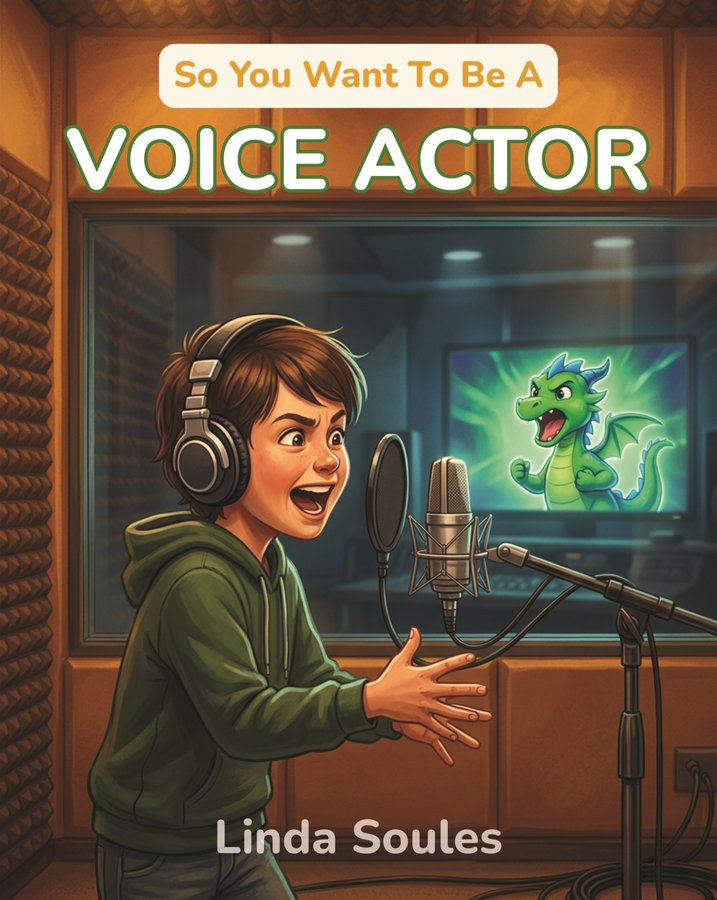
So You Want To Be A Voice Actor
by Linda Soules
MOST HONEST GRIEF BOOKY
Takes you to this book's Amazon page.
The judge's reasoning
Linda Soules has written a career book that keeps doing something career books almost never do: it makes you feel something. The emotional core of So You Want To Be A Voice Actor isn't the practical scaffolding — the microphone tips, the ADR explainer, the day-in-the-life schedule — it's the recurring insistence that what voice actors do is an act of love toward children they will never meet. The passage about the four-year-old in pajamas watching the dragon and the brave mouse is genuinely moving, and it earns its sentiment because Soules has already built the philosophical case for why a voice can be a relationship: "The voice a child hears when they picture their favorite cartoon is a real person who decided exactly how that character laughs. That voice lives in the memories of millions."
The prose is doing real work here, not just delivering information. Soules writes in clean, declarative rhythms that mirror the subject — punchy, rhythmic, built for reading aloud, which is quietly self-referential and quietly perfect. "The voice actor who truly feels sad makes the audience sad. The voice actor who merely sounds sad makes the audience check their phone." That's a sentence a middle-grade reader will remember. The Author's Note, which tracks backward from Soules's own childhood memories of voices to the present-day reader, lands with genuine warmth and specificity. The closing line — "Those characters are not in the world yet. They are waiting in your voice" — is the kind of ending that makes a kid close a book and immediately want to pick up something to read aloud. For the reader this book is actually for — a curious 10-to-12-year-old who has always done the voices — it knows them exactly.

Judged by Brooke Hayes — Reader-at-Large · Cross-Genre · Emerging Voices
"Every book is the only book for somebody."
Supporting passages
"The voice a child hears when they picture their favorite cartoon is a real person who decided exactly how that character laughs. That voice lives in the memories of millions — and sometimes in the memories of the next generation too, when those children grow up and share the cartoon with their own kids."
This sentence quietly reframes a career fact into an intergenerational emotional inheritance, which is exactly the kind of resonance that makes a child feel the weight of what they might one day do.
"The voice actor who truly feels sad makes the audience sad. The voice actor who merely sounds sad makes the audience check their phone. The microphone is the ultimate truth detector."
The parallel structure earns its punch, and the final sentence lands with the clean confidence of a writer who knows exactly what rhythm a middle-grade reader can carry.
"Every child who reads a story aloud and gives the dragon a big deep voice and the princess a bright determined voice — that child is doing exactly what professionals do. Every child who talks to a stuffed animal in a different voice is creating a character. The booth is just a quieter room. The microphone is just a tool. The voice is the magic — and the voice is already there."
This is the book's thesis delivered at its most generous: it doesn't just describe a career, it tells the reader they've already begun — a theme of inherent capability that runs through the entire text.
Per-axis rubric scores
Every Booky-winning book is scored across all ten craft axes. The award category comes from the top axis; a second axis at or above 75 appears as secondary recognition.
Find out what your book does best.
Submit your book today. Get a real, honest, category-specific Booky — or every dollar back.
Submit Your Book → Screen Another Book