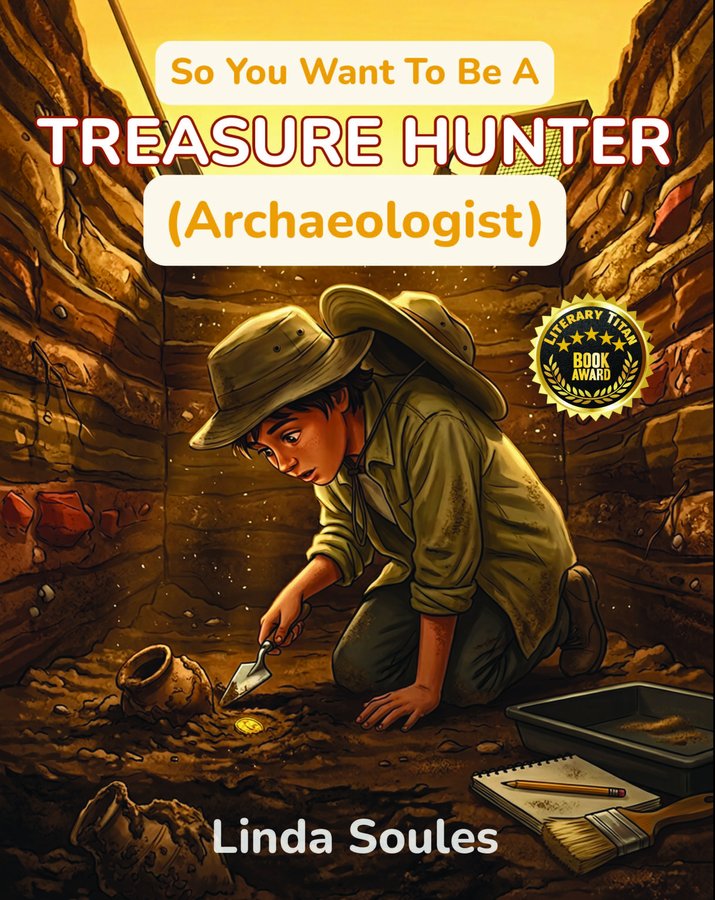
So You Want To Be A Treasure Hunter (Archaeologist)
by Linda Soules
SENTENCE-LEVEL MASTERY BOOKY
Takes you to this book's Amazon page.
The judge's reasoning
Linda Soules writes middle-grade non-fiction the way it almost never gets written: as prose that earns its keep sentence by sentence.
The opening pages of So You Want To Be A Treasure Hunter (Archaeologist) do something genuinely difficult — they make epistemology exciting. "Here is the secret that separates the archaeologist from the looter" is the kind of pivot that reframes everything that follows, and Soules earns it with specificity: the same gold coin, two different contexts, two completely different stories. That is not simplified-for-kids writing. That is clear thinking rendered in clean prose, and it respects the reader.
The book's controlling metaphor — archaeology as an act of listening rather than extracting — is developed with remarkable consistency. The trowel that "reveals" rather than digs. The notebook that outlasts the trench. "The site is not the prize. The site is the inheritance." These aren't decorative lines; they do conceptual work, building a child's understanding of why method matters in a discipline most books reduce to finding gold.
The Theme & Substance axis earns recognition because the ethical spine of this book is never preachy and never ornamental. The section on cultural humility — archaeology done with communities, not on them — is woven into the structure of every section, culminating in the image of a grandmother who tells you which plants the elders gathered, or a village kid who joins the next generation of archaeologists. For a book aimed at 10-to-14-year-olds, this is unusually serious and unusually well-placed.
The author's note closes with a sentence that lands: "The cup is here. She was here. That is enough to begin." That's the book in miniature — and it's earned.

Judged by Brooke Hayes — Reader-at-Large · Cross-Genre · Emerging Voices
"Every book is the only book for somebody."
Supporting passages
"A gold coin found loose tells us: this is a gold coin from approximately this period. The same gold coin found in a specific layer, next to a burned wall, with destruction debris, tells a rich story about when the destruction happened, what caused it, and who lived there."
This is the book's central lesson delivered with the precision of good explanatory prose — the repeated structure ('found loose' vs. 'found in a specific layer') does the teaching without needing a diagram.
"History books tell the stories of kings — the pharaohs, the emperors, the conquerors. But the archaeological record tells the stories of everyone: the farmer who grew the grain, the potter who made the jar, the mother who cooked the meal, the child who lost the toy, the trader who carried the beads, the builder who laid the wall."
The anaphoric list turns a thematic argument into something that feels like discovery — the rhythm enacts the democratizing claim the book is making.
"Picture the discipline this requires. Every time the trowel lifts a layer, a door closes that no one will ever open again. The archaeologist has one chance to record what was behind it. After that, the layer exists only in the notebook on the table."
Soules makes irreversibility — an abstract methodological concept — visceral and consequential for a young reader through a single, well-chosen image.
Per-axis rubric scores
Every Booky-winning book is scored across all ten craft axes. The award category comes from the top axis; a second axis at or above 75 appears as secondary recognition.
Find out what your book does best.
Submit your book today. Get a real, honest, category-specific Booky — or every dollar back.
Submit Your Book → Screen Another Book