
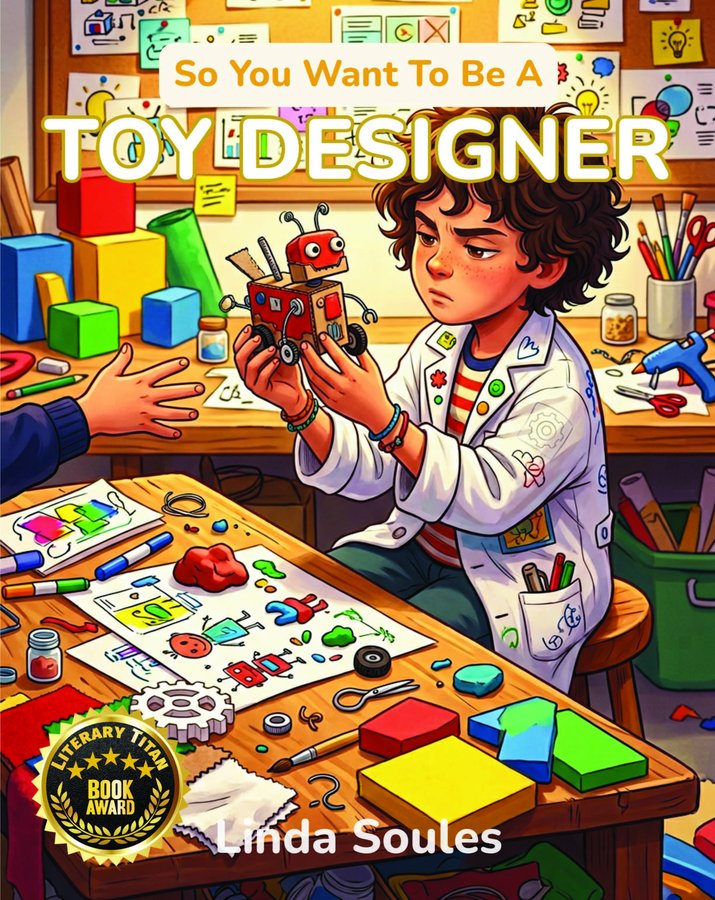
So You Want To Be A Toy Designer
by Linda Soules
BEST ARGUMENT BOOKY
Takes you to this book's Amazon page.
The judge's reasoning
Linda Soules has written a career-exploration book that earns something most books in this format don't attempt: a genuine argument. So You Want To Be A Toy Designer doesn't just describe what toy designers do — it advances a thesis about what play is, and it trusts a middle-grade reader to follow that thesis from first page to last. The central paradox — that a toy designed with more features often delivers less play, and that the greatest toys in history are the ones that leave room for the child's imagination to finish the job — is not a fun fact. It's a coherent philosophy of design, stated plainly and then demonstrated through every section that follows.
The prose is the delivery mechanism for that philosophy, and it's genuinely good. Soules writes in short declarative sequences that carry real compression: "The prototype is the designer's question. The child's play is the answer." The rhythm is earned, not decorative. The book also handles emotional weight without sentimentality — the description of watching a child ignore your prototype behind a one-way mirror, the stuffed rabbit that travels between generations carrying "the warmth of its history" — these land because they're specific and unsentimental.
The closer, in the Author's Note, is the best page in the book: "The doll that looked like her told a small girl that her face belonged in the category of things worth making." That sentence does serious work. For a series officially targeted at ages 10–14, this book consistently meets its readers eye to eye rather than talking down to them — and it gives any curious kid a real framework for thinking about design, play, and who the world is made for.

Judged by Brooke Hayes — Reader-at-Large · Cross-Genre · Emerging Voices
"Every book is the only book for somebody."
Supporting passages
"The designer who designs more — more features, more sounds, more actions — often creates a toy that does less. Less room for imagination, less creative play, less lasting engagement. And the designer who designs less — fewer features, simpler forms, more open-ended possibilities — creates a toy that does more: more imagination, more creativity, more years of play."
This is the book's core argument stated at its sharpest — a genuine design philosophy delivered in prose a ten-year-old can follow and remember.
"The prototype is the designer's question. The child's play is the answer. If the child plays: the design works. If the child puts it down after a minute: the design fails."
The short declarative rhythm here does real compression work — it's clean, memorable, and models the same economy of form the book argues great toys embody.
"The doll that looked like her told a small girl that her face belonged in the category of things worth making. The doll that didn't look like her told her something else."
This passage earns its emotional weight through specificity and restraint — it makes a large claim about representation without overexplaining, and it's the kind of sentence a young reader carries with them.
Per-axis rubric scores
Every Booky-winning book is scored across all ten craft axes. The award category comes from the top axis; a second axis at or above 75 appears as secondary recognition.
Find out what your book does best.
Submit your book today. Get a real, honest, category-specific Booky — or every dollar back.
Submit Your Book → Screen Another Book