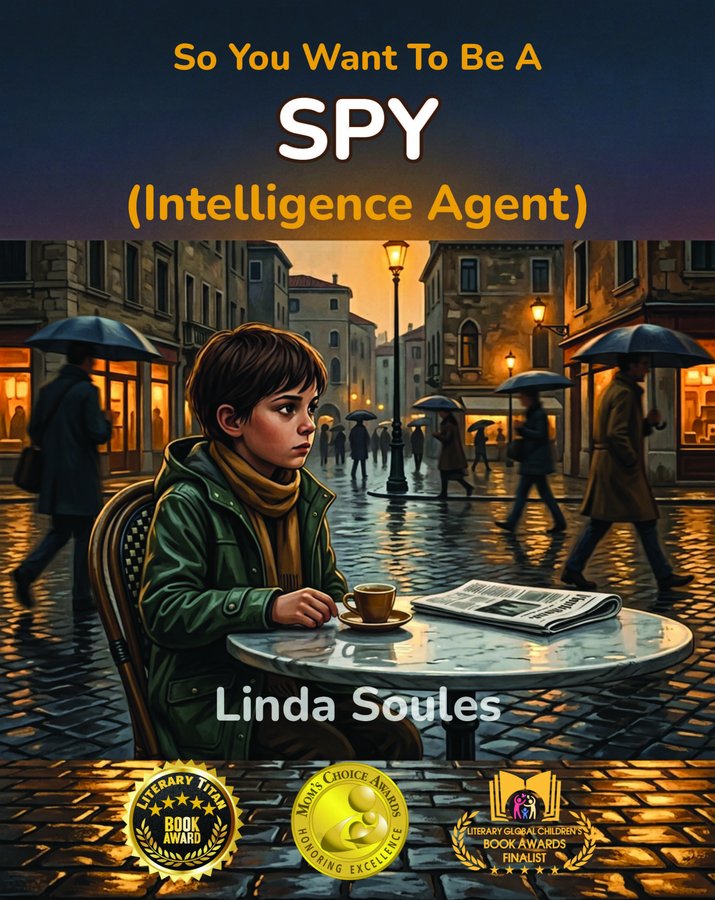
So You Want To Be A Spy (Intelligence Agent)
by Linda Soules
BEST TREATMENT OF FAMILY BOOKY
Takes you to this book's Amazon page.
The judge's reasoning
Linda Soules is doing something genuinely harder than it looks here: she is writing honestly to children about a profession that is constitutionally built on deception, and she makes the honesty the point. The book's central argument — that the real courage of intelligence work is epistemic, not physical — is delivered with remarkable clarity and without condescension. The passage on confirmation bias is a standout: "They don't just look for evidence that proves they're right. They actively go searching for evidence that might prove they're wrong. They ask themselves: what would change my mind? If the honest answer is 'nothing' — if no amount of evidence could ever convince them they're mistaken — then they're not really analyzing anymore." This is a concept most adults cannot articulate that cleanly. That it's here, in a middle-grade career guide, addressed directly to a ten-year-old, is a real achievement.
The prose throughout earns its directness. The opening — "Thousands of pieces arrive every day, in dozens of languages, from hundreds of sources — some reliable, some unreliable, some deliberately false" — establishes a tone of serious respect for the reader that the book sustains all the way through to the author's note. The Famous Spies section is perfectly weighted: Harriet Tubman as intelligence operative, Noor Inayat Khan who "never gave up a single name," Virginia Hall escaping over the Pyrenees in winter and going back. These aren't names chosen for easy drama; they are chosen to complicate the reader's understanding of what the job actually requires. The glossary entry for Analytic Integrity — "the analyst reports what the evidence shows, not what the decision-maker wants to hear" — is the kind of value proposition that a child will carry forward into every context where it matters. This book knows exactly who it's for, and it takes that reader completely seriously.
Judged by Brooke Hayes — Reader-at-Large · Cross-Genre · Emerging Voices
"Every book is the only book for somebody."
Supporting passages
"They don't just look for evidence that proves they're right. They actively go searching for evidence that might prove they're wrong. They ask themselves: what would change my mind? If the honest answer is 'nothing' — if no amount of evidence could ever convince them they're mistaken — then they're not really analyzing anymore. They're just believing something and calling it analysis."
This is a lucid, age-appropriate explanation of confirmation bias that doubles as a genuine lesson in intellectual honesty — rare in any book, let alone a middle-grade career guide.
"The best outcomes are the ones where nothing bad ever happened — and nobody knows why. When it goes well, there is nothing to see. Just normal days continuing for ordinary people who never knew how close things came to disaster."
This sentence earns its quiet weight through understatement; the rhythm slows at exactly the right moment to let the stakes land without melodrama.
"Imagine doing something brave and important and then never being able to tell anyone. Ever. That's not in the movies very much — but it's very real."
The blunt two-word sentence 'Ever.' followed by the pivot away from the movie version reframes the entire genre expectation the reader walked in with — this is the book doing its real thematic work.
Per-axis rubric scores
Every Booky-winning book is scored across all ten craft axes. The award category comes from the top axis; a second axis at or above 75 appears as secondary recognition.
Find out what your book does best.
Submit your book today. Get a real, honest, category-specific Booky — or every dollar back.
Submit Your Book → Screen Another Book