
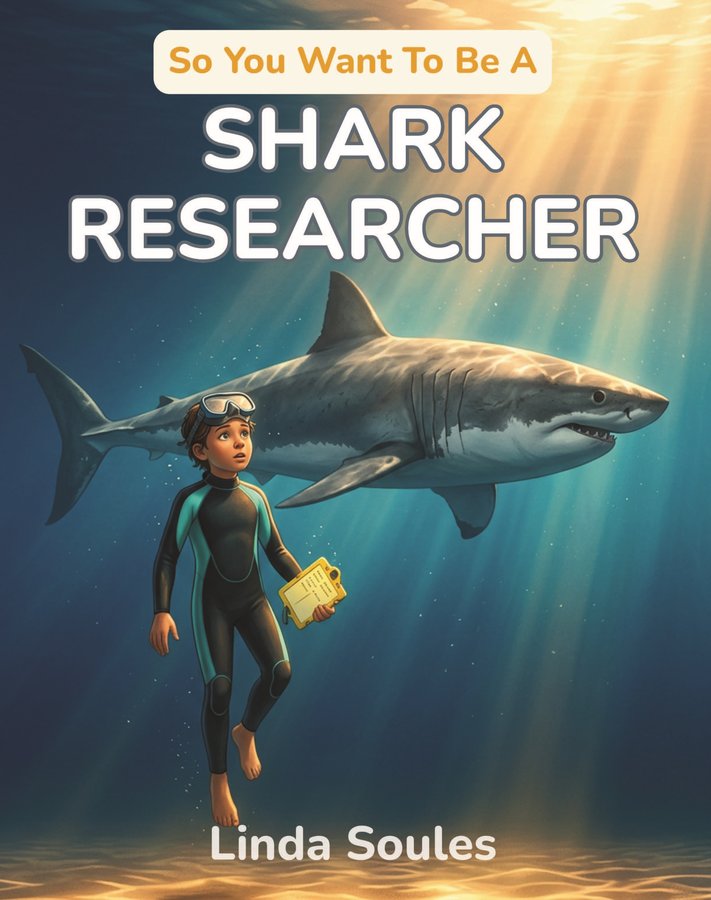
So You Want To Be A Shark Researcher
by Linda Soules
BEST TREATMENT OF AGEING BOOKY
Takes you to this book's Amazon page.
The judge's reasoning
Every book is the only book for somebody — and this one is for the kid who already loves sharks but has never been handed a book that treats that love as serious, consequential, and worthy of a career.
So You Want To Be A Shark Researcher earns its highest marks for Theme & Substance because it refuses to settle for wonder alone. Linda Soules layers ecological argument, conservation urgency, and vocational honesty into what could have been a simple facts-and-photos book. The statistic that anchors the whole project — 100 million sharks killed by humans per year versus fewer than ten people killed by sharks — is deployed early and without softening, and the book keeps returning to it in different registers. The work is framed explicitly as "a kind of rescue mission," and the chapter on hardships names the specific psychological weight of "spending a career studying animals of real ecological importance while contending with a cultural narrative that works against every conservation argument."
The prose is doing real work throughout. The Author's Note closes with a passage that earns its emotional stakes: "A tag deployed this summer will, decades from now, be part of the argument that saves a species... Most of what a shark researcher plants, someone else harvests. That is not a reason to stop planting. It is the reason planting matters." That's not boilerplate career-guide copy. That's a genuine philosophy of vocation, written at a level that respects young readers without condescending to them.
The "Most Surprising Thing" section — revealing that sharks predate trees, flowers, and land vertebrates — is the kind of specific, mind-bending fact that makes a middle-grade reader stop and reread a paragraph. Soules consistently earns her wonder rather than just asserting it.

Judged by Brooke Hayes — Reader-at-Large · Cross-Genre · Emerging Voices
"Every book is the only book for somebody."
Supporting passages
"Humans kill approximately 100 million sharks every year — for their fins, for sport, and as accidental bycatch in fishing nets. Meanwhile, sharks kill fewer than ten people worldwide in an average year. We are not afraid of the right thing."
This is the book's moral core delivered in three sentences — the third a rhetorical punch that reframes the reader's relationship to fear and makes the conservation argument personal and immediate.
"It swam through oceans that didn't have a name yet. It is not an ancient creature. It is a design solution that has been current for almost half a billion years."
The pivot from poetic image to engineering metaphor in three short sentences shows Soules working at the seam of wonder and precision — exactly the register this audience needs.
"Most of what a shark researcher plants, someone else harvests. That is not a reason to stop planting. It is the reason planting matters."
A quietly profound statement about long-horizon science and faith in collective work, landing the book's thematic argument with the kind of earned compression that makes a middle-grade reader underline a sentence.
Per-axis rubric scores
Every Booky-winning book is scored across all ten craft axes. The award category comes from the top axis; a second axis at or above 75 appears as secondary recognition.
Find out what your book does best.
Submit your book today. Get a real, honest, category-specific Booky — or every dollar back.
Submit Your Book → Screen Another Book