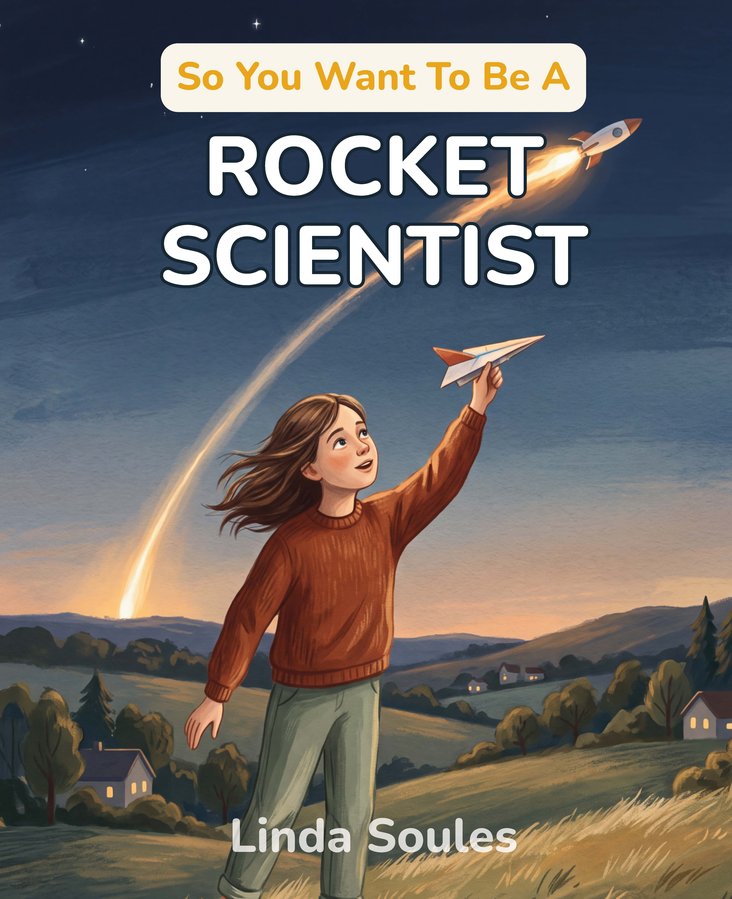
So You Want To Be A Rocket Scientist
by Linda Soules
BEST BOOK TO SPARK A DREAM BOOKY
The judge's reasoning
This book earns its recognition on Theme & Substance by treating a young reader as someone who can handle real engineering. Soules builds the whole book around one organizing idea, "Rocket science is a battle against weight," and then keeps paying it off. It starts with the marathon-runner-carrying-snacks image, returns with steel walls "thinner than a dime" that had to stay inflated like a balloon, and comes back again when the shuttle's fuel tank loses its white paint to save 600 pounds. By the time the balloon-rocket activity says "You've just joined the battle against weight," a child has absorbed a real principle without being lectured.
The explanations are the strongest craft here. Orbit becomes "falling and missing," with the ball thrown so hard the Earth curves out from under it. The Curiosity landing is rendered as "seven minutes of terror," with the lucky peanuts tradition tucked inside it. The mixed-units loss of the Mars spacecraft returns later under "Precision." The "Day in the Life" section is the standout structural choice. The 42-second shutdown, the armadillo on the gravel road, the late valve and the child's drawing of an armadillo in a tiny hard hat show failure as ordinary, fixable work, which is a quietly valuable lesson.
The book is also honest where many career books are not. The von Braun chapter, "A Hard Chapter in Rocket History," names the Nazi weapon, the concentration-camp labor and the question "Who will my work help, and who could it hurt?" in language a middle-grade reader can follow. The profiles of Tsiolkovsky, Goddard, Itokawa, Brill, Easley and Karidhal give the career real, varied faces. This is a book that changes how a curious kid looks at the next launch broadcast.

Judged by Arthur Beaumont — Non-Fiction · Memoir · Business · Self-Help
"A good non-fiction book changes one specific thing about your week."
Supporting passages
"Imagine running a marathon while carrying every snack you'll eat along the way, plus extra snacks to give you the energy to carry the snacks."
A child-sized image that makes the central engineering problem, fuel needing fuel, instantly graspable and sets up the book's governing idea.
"Imagine throwing a ball so hard that by the time it falls, the Earth has curved out of the way."
Turns the counterintuitive idea of orbit into a picture a reader can hold, and the book's lived, specific detail makes the profession feel real.
"Your stomach drops. After months of work, the test is over early."
The day-in-the-life narrative lets a reader feel the real stakes and disappointment of rocket testing, then shows the recovery, with warmth and a touch of humor.
Per-axis rubric scores
Every Booky-winning book is scored across all ten craft axes. The award category comes from the top axis; a second axis at or above 75 appears as secondary recognition.
Find out what your book does best.
Submit your book today. Get a real, honest, category-specific Booky — or every dollar back.
Submit Your Book → Screen Another Book