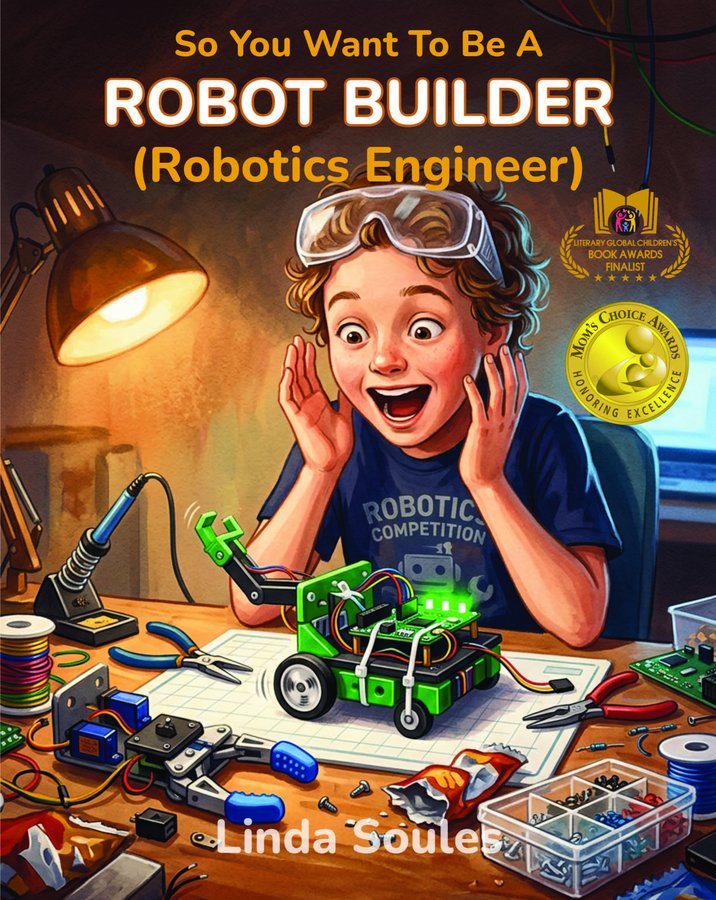
So You Want To Be A Robot Builder (Robotics Engineer)
by Linda Soules
BEST USE OF RHYTHM BOOKY
Takes you to this book's Amazon page.
The judge's reasoning
Linda Soules writes nonfiction for kids the way a good mentor talks: directly, without condescension, and with genuine delight in the subject. The prose in So You Want To Be A Robot Builder earns its award not through ornament but through precision — the kind of precision the book itself celebrates. The opening definition of a robot — "sense the world, think about what it senses, and act on what it thinks. Sense. Think. Act. Three words. Three abilities." — is exactly what good explanatory writing looks like: concrete, rhythmic, and memorable. Soules has a gift for the aphoristic turn that sticks: "The robot does not do what you want. It does what you told it to do. And those are almost never the same thing." That sentence could hang on a classroom wall.
What elevates this above workmanlike nonfiction is that the style is doing work. The parallel triads ("body," "nervous system," "brain"; "mechanical, electrical, software") aren't decorative — they mirror the interdisciplinary structure of the field itself. The "A Day in the Life" section moves with the same iterative rhythm the book describes: test, fail, learn, try again. And the closing note — "The workbench is ready. The parts are waiting. The code is open." — is a genuine invitation, not a generic sign-off.
On Theme & Substance, Soules doesn't flinch from the ethical weight of the field. The section on how robots "carry the values of the people who built it" into operating rooms and rescue sites asks middle-grade readers to take seriously a question that many adult readers dodge. That's rare, and it's earned.

Judged by Brooke Hayes — Reader-at-Large · Cross-Genre · Emerging Voices
"Every book is the only book for somebody."
Supporting passages
"The robot does not do what you want. It does what you told it to do. And those are almost never the same thing. The gap between what you mean and what you write is where most of the work lives."
This is the book's sharpest sentence — it names a universal engineering truth in language a ten-year-old can carry with them, and it lands with the force of a proverb.
"Every robot that operates in the world carries its builder's choices inside it, invisibly, in every instruction. That is what makes this work different from almost every other kind of engineering. The robotics engineer is not just designing a machine. They are encoding a thousand small judgments about how a machine should behave when it meets a person, when it sees an obstacle, when something goes wrong."
Soules asks a genuinely serious ethical question — who is responsible for what a robot does — and trusts her middle-grade audience to sit with it, which is exactly what the best nonfiction for young readers does.
"Build with whatever you have. Use cardboard, tape, craft sticks, rubber bands. Make the strongest thing you can, then figure out how to make part of it move. If it moves, senses, or responds to the world — even a little, even badly — you have built a robot."
The 'What You Can Do Right Now' section delivers on the series' promise — this is actionable, affordable, and inclusive guidance that meets kids where they actually are, not where a classroom budget would like them to be.
Per-axis rubric scores
Every Booky-winning book is scored across all ten craft axes. The award category comes from the top axis; a second axis at or above 75 appears as secondary recognition.
Find out what your book does best.
Submit your book today. Get a real, honest, category-specific Booky — or every dollar back.
Submit Your Book → Screen Another Book