
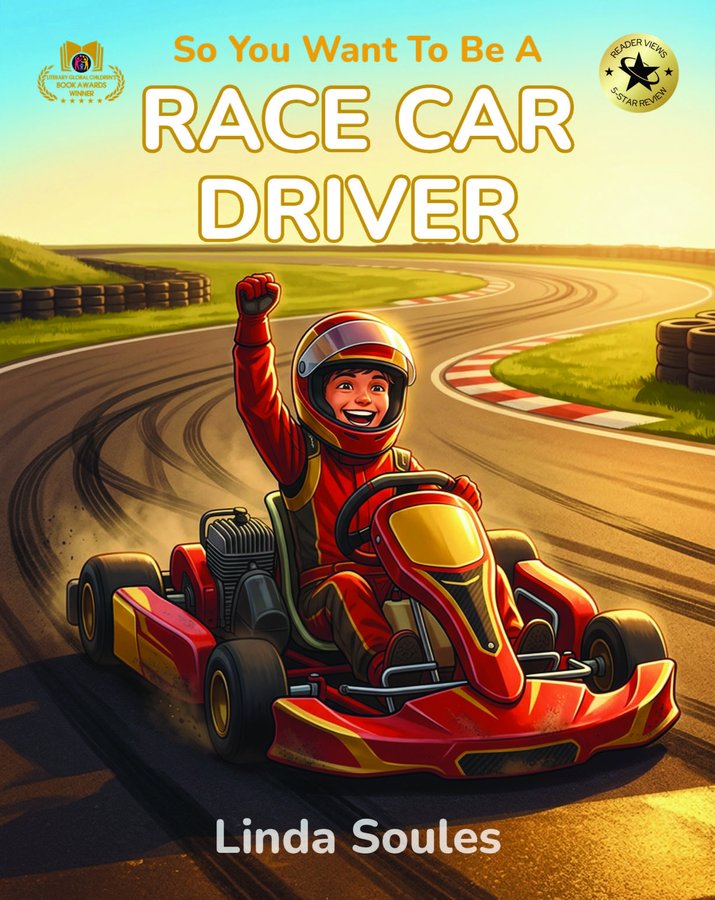
So You Want To Be A Race Car Driver
by Linda Soules
BEST HISTORICAL FICTION BOOKY
Takes you to this book's Amazon page.
The judge's reasoning
So You Want To Be A Race Car Driver does something genuinely hard well: it makes a career book feel like it has a point of view. Linda Soules opens with a provocation — "You think speed is about going fast. It is not" — and that single move tells you everything about what this book is doing. It refuses to be the thing you expect. The counterintuitive hook (smooth is fast; the best drivers are the calmest) runs through the entire text as a through-line, giving what could easily be a listicle the spine of an argument.
For its intended reader — a curious 10-to-12-year-old who doesn't yet know they're interested in physics, strategy, or emotional regulation — this book consistently delivers more than promised. The "Day in the Life" section is especially well-executed: the hour-by-hour structure gives middle-grade readers a concrete scaffold while the details (chasing a single tenth of a second in Turn Seven all day) make the stakes feel real. The glossary is one of the better ones in this format — each entry reads like a small poem: "The invisible thread the driver follows" for Racing Line; "Racing's greatest achievement" for Survival Cell.
The Famous Drivers section lands with genuine feeling. The Danica Patrick entry — "She didn't just break a barrier; she drove through it at full speed and never looked back" — earns its momentum. The prose throughout trusts young readers with real information without condescending, which is exactly what this series promises and what this title delivers.

Judged by Brooke Hayes — Reader-at-Large · Cross-Genre · Emerging Voices
"Every book is the only book for somebody."
Supporting passages
"You think speed is about going fast. It is not. Going fast is easy; press the accelerator (the gas), and the engine does the rest. Any machine with enough power can reach high speeds in a straight line. That is just physics doing its job. Racing is about going fast around corners."
This opening move — a counter-intuitive reframe delivered in plain, confident sentences — immediately earns the reader's attention and sets the book's instructional voice apart from standard career non-fiction.
"She didn't just break a barrier; she drove through it at full speed and never looked back."
A single sentence that earns its metaphor by paying off the book's central conceit — speed as a way of being — while landing real emotional weight in the Famous Drivers section.
"Here's something people don't always realize: the race car drivers who last the longest are quietly some of the most intelligent athletes in any sport. They understand physics. They read weather, tire wear, and track temperature. They know exactly when to push and when to wait. Racing is not just bravery. It is brilliance wrapped in a helmet."
This passage crystallizes the book's core thesis — that racing rewards intelligence and precision over aggression — and delivers it in a formulation memorable enough to stick with a middle-grade reader long after they've closed the book.
Per-axis rubric scores
Every Booky-winning book is scored across all ten craft axes. The award category comes from the top axis; a second axis at or above 75 appears as secondary recognition.
Find out what your book does best.
Submit your book today. Get a real, honest, category-specific Booky — or every dollar back.
Submit Your Book → Screen Another Book