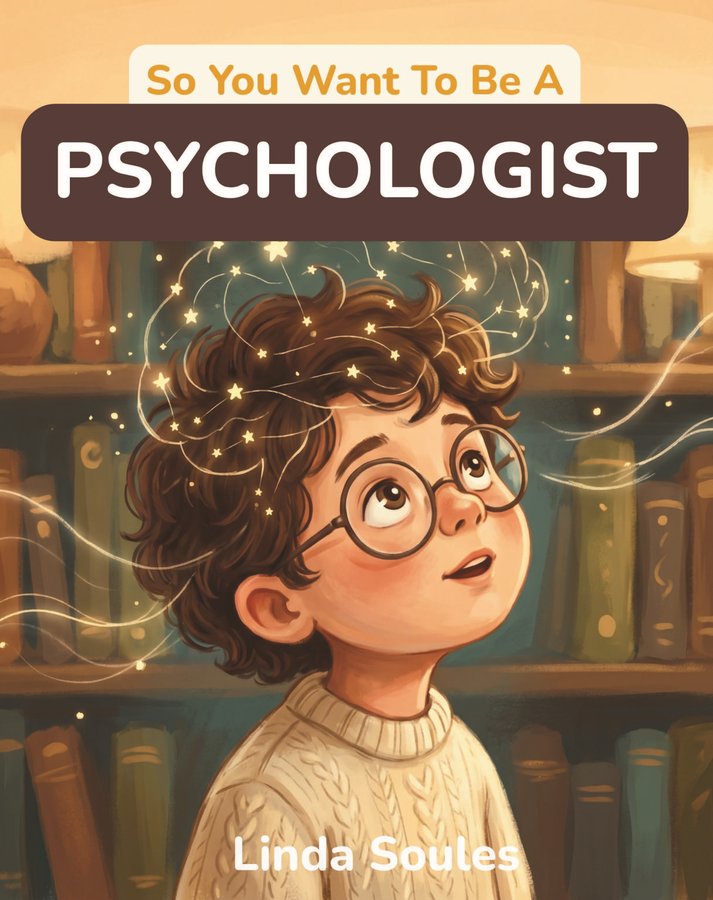
So You Want To Be A Psychologist
by Linda Soules
BEST BOOK TO SPARK A DREAM BOOKY
The judge's reasoning
This book knows exactly what it's doing: it takes a profession most kids picture as "two chairs and a couch" and cracks it open into something bigger, stranger, and more useful. The Clever Hans story, the Stroop-effect color trap, the rubber-hand illusion, and the invisible gorilla experiment aren't just fun facts bolted on — they're doing the actual work of teaching the scientific habit of mind the book keeps insisting is the whole job: ask a clear question, gather real evidence, and change your mind when the evidence tells you to. That's a genuinely sophisticated idea to hand a nine-year-old, and Soules trusts the reader enough to say it plainly rather than dumbing it down.
The structural choices back this up. The "Day in the Life" section (9:00 AM assessment, 2:00 PM lab meeting arguing gently over graphs, 6:00 PM "the workday ends, on purpose") gives the profession lived texture instead of a job-description list. The Famous Psychologists section does real work too — Martha Bernal's entry, in particular, doesn't flatten her into an inspirational footnote; it names the specific unfairness she faced and the specific way her later research reshaped the field's honesty about who gets studied.
The closing line — "you matter too much for us to get you wrong" — is the kind of sentence that earns its place because the whole book has been building toward it: precision as a form of respect, not coldness. For a curious kid who keeps asking why, and isn't satisfied by the first answer, this delivers exactly what it promises on the cover.

Judged by Brooke Hayes — Reader-at-Large · Cross-Genre · Emerging Voices
"Every book is the only book for somebody."
Supporting passages
"A psychologist trains for years to do the unnatural thing instead, to go hunting for the evidence that might prove her own favorite idea wrong."
Distills the scientific mindset into a single memorable, age-appropriate sentence that the whole book keeps returning to.
"9:00 AM – An assessment with a nine-year-old whose teacher and parents cannot figure out why reading is such a struggle. You sit at a low table and move gently through carefully chosen tasks"
The day-in-the-life structure grounds an abstract profession in concrete, sequential, sensory detail a child can follow.
"you matter too much for us to get you wrong."
A quietly powerful closing thought that reframes scientific precision as an act of care rather than coldness.
Per-axis rubric scores
Every Booky-winning book is scored across all ten craft axes. The award category comes from the top axis; a second axis at or above 75 appears as secondary recognition.
Find out what your book does best.
Submit your book today. Get a real, honest, category-specific Booky — or every dollar back.
Submit Your Book → Screen Another Book