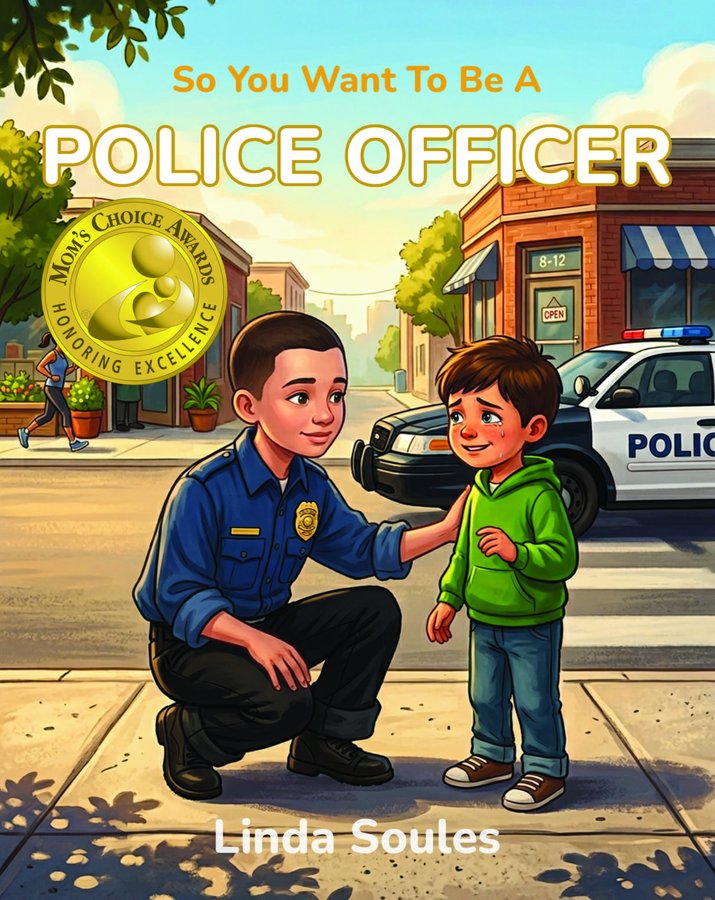
So You Want To Be A Police Officer
by Linda Soules
BEST MEMOIR VOICE BOOKY
Takes you to this book's Amazon page.
The judge's reasoning
So You Want To Be A Police Officer knows exactly who it's for and serves that reader with uncommon seriousness. In a crowded field of career-exploration books that flatten complex jobs into cheerful bullet points, Linda Soules does something genuinely harder: she tells middle-grade readers the truth. The job is mostly not chasing bad guys. Eyewitness testimony is unreliable. Officers carry split-second decisions that get reviewed for months afterward. Mental health calls outnumber crime calls four to one. This is a book that trusts a ten-year-old to hold complexity, and that trust is its defining strength.
The structure is exceptionally well-calibrated for the form — short, titled sections that each earn their place, building from what the job actually is through the hardest parts, the surprising parts, and finally arriving at a "Note from the Author" that delivers the book's moral weight without condescension: "the power of the badge is real, and so is the responsibility." That arc is genuinely crafted, not assembled.
The prose does real work. The section on listening — "When someone calls the police, they're usually having one of the worst days of their life" — earns its emotional register because the whole book has been building toward it. The glossary entries go beyond definitions to carry the book's values ("A badge represents duty, responsibility, and public trust"). And the historical profiles of Georgia Ann Robinson and Beverly Harvard give the book both diversity and genuine historical weight rather than tokenism.
For a middle-grade reader who wants to understand what police work actually demands — not a sanitized version, not a cynical one — this book is genuinely the right object. Genre execution at its most purposeful.

Judged by Brooke Hayes — Reader-at-Large · Cross-Genre · Emerging Voices
"Every book is the only book for somebody."
Supporting passages
"The majority of calls that police respond to are not crimes. Studies consistently find that over eighty percent of calls involve mental health crises, neighbor disputes, noise complaints, welfare checks, traffic issues, or people who are confused or lost or frightened. The police are the primary response infrastructure for social problems that have no other responder."
This passage exemplifies the book's core genre strength: delivering genuinely surprising, research-grounded information to middle-grade readers without dumbing it down or hedging away from complexity.
"Here is something this book has not said directly, because it is difficult to say: police officers carry authority that very few other people have. They can tell people to stop. They can search. They can arrest. In the most extreme circumstances, they can use force that changes or ends a life. That authority exists because communities need it — but it works only when the person who holds it understands, every single day, that it belongs to the community, not to them."
The "Note from the Author" lands the book's central ethical argument with directness and moral precision — rare in career-exploration books aimed at this age group.
"The officer who has covered the same beat for years knows its geography intimately — the faces that belong and the ones that are unfamiliar."
A single sentence that conveys years of accumulated knowledge and the human dimension of patrol work with quiet economy — the prose doing more than the words strictly require.
Per-axis rubric scores
Every Booky-winning book is scored across all ten craft axes. The award category comes from the top axis; a second axis at or above 75 appears as secondary recognition.
Find out what your book does best.
Submit your book today. Get a real, honest, category-specific Booky — or every dollar back.
Submit Your Book → Screen Another Book