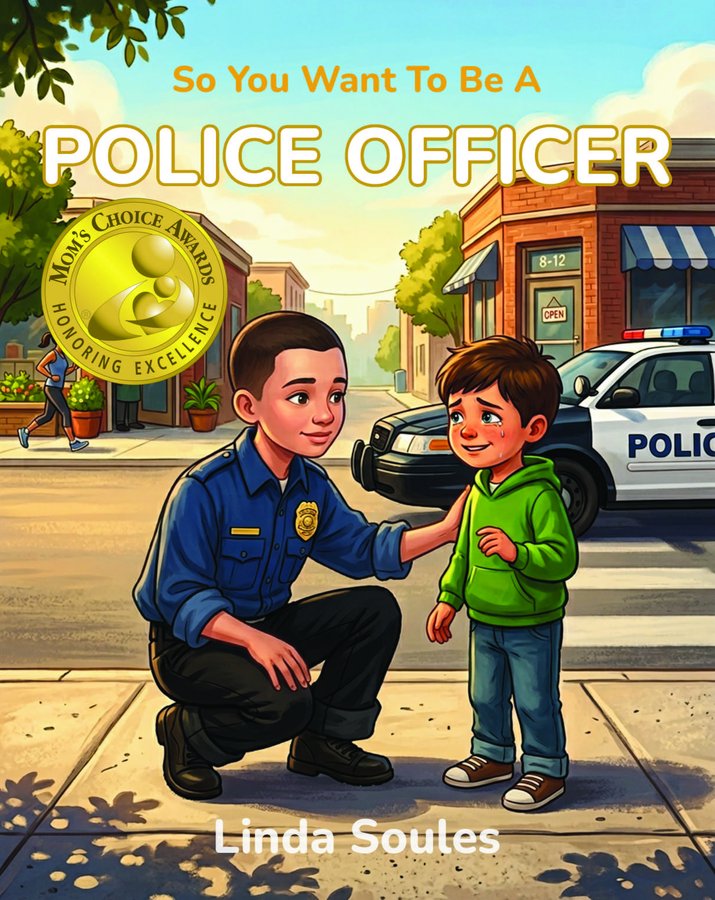
So You Want To Be A Police Officer
by Linda Soules
BEST TREATMENT OF CLASS BOOKY
Takes you to this book's Amazon page.
The judge's reasoning
So You Want To Be A Police Officer does something genuinely difficult in middle-grade nonfiction: it refuses to flatten its subject. Linda Soules writes about policing with the kind of moral seriousness that respects a ten-year-old's ability to hold complexity. The book tells young readers, straight, that "over eighty percent of calls involve mental health crises, neighbor disputes, noise complaints" — not crime scenes — and then asks them to sit with what that means about who police officers actually are and what we ask of them. That's real substance delivered without condescension.
The thematic architecture is unusually coherent for the genre. Every section — from "The Hardest Parts" to "Mental Health and Crisis Literacy" — builds toward the same central argument: that the most powerful tool in law enforcement is not on the duty belt, it's the capacity to listen. The Author's Note lands this with quiet force: "The power of the badge is real, and so is the responsibility. Use both carefully." That's not a platitude; it's earned by everything that came before it.
The prose style matches the ambition. Sentences like "You can't protect a community you don't know" and the description of a good officer's day — fender bender, lost dog, worried neighbor — work because they're specific and cumulative, not because they're flashy. The historical profiles of Georgia Ann Robinson and Beverly Harvard are particularly well-chosen: they do thematic work, not just representation work, illustrating that trust is built over careers and against resistance. This book knows who it's for — the kid who wants to help — and it meets them exactly there.

Judged by Brooke Hayes — Reader-at-Large · Cross-Genre · Emerging Voices
"Every book is the only book for somebody."
Supporting passages
"You can't protect a community you don't know. And you can't know a community unless you're part of it."
This two-sentence thesis does the work of the entire book's central argument in language any middle-grade reader can carry with them.
"The decision made in seconds is evaluated across months, by people with complete information and no time pressure."
A quietly devastating sentence that gives young readers a genuinely adult-level insight into the moral weight of the job without editorializing.
"The officers I most admire are the ones who feel the weight of that. Not the ones who are paralyzed by it — but the ones who carry it honestly, who understand that the badge means they are held to a higher standard, not released from one."
The Author's Note earns its emotional register because it's specific about what admirable looks like rather than retreating to generic inspiration.
Per-axis rubric scores
Every Booky-winning book is scored across all ten craft axes. The award category comes from the top axis; a second axis at or above 75 appears as secondary recognition.
Find out what your book does best.
Submit your book today. Get a real, honest, category-specific Booky — or every dollar back.
Submit Your Book → Screen Another Book