
So You Want To Be A Pilot
by Linda Soules
BEST USE OF RESTRAINT BOOKY
Takes you to this book's Amazon page.
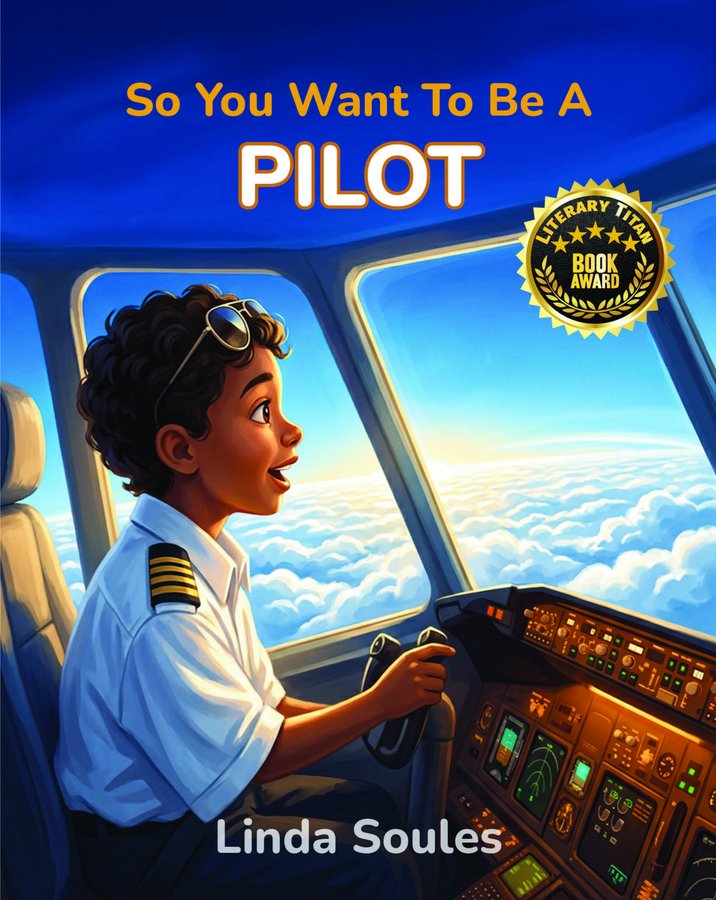
The judge's reasoning
So You Want To Be A Pilot earns its Booky on the strength of prose that has no business being this good in a middle-grade career guide — and knows it. Linda Soules writes with the compressed momentum of someone who has thought hard about what each sentence needs to carry. The opening sequence — "Slowly at first. Then faster. Then FAST. The speed builds — 120 miles per hour, 140, 160, 180 — and the nose lifts and the wheels leave the ground and the Earth falls away and you are flying" — is not a description of takeoff. It is a takeoff. The acceleration is in the syntax.
This control holds throughout. The 'A Day in the Life' section's closing line — "walk through the terminal, a regular person among regular people, carrying a day that most of them couldn't imagine" — is the kind of sentence that ten-year-olds will feel without being able to name why. The Sully Sullenberger passage delivers what should be a familiar story and makes it land fresh: "he'd been depositing small amounts in a bank of experience for forty-two years, and on January 15 he made one large withdrawal. That is what training is for. That is what training is." The repetition isn't accidental — it earns its weight.
On Theme & Substance, the Author's Note reframes the entire book's argument: commercial aviation is safe not because of heroes but because of a culture of honest failure analysis. That's a genuinely sophisticated idea delivered to a young reader without condescension. This book trusts its audience, which is the rarest quality in the genre.

Judged by Brooke Hayes — Reader-at-Large · Cross-Genre · Emerging Voices
"Every book is the only book for somebody."
Supporting passages
"Slowly at first. Then faster. Then FAST. The speed builds — 120 miles per hour, 140, 160, 180 — and the nose lifts and the wheels leave the ground and the Earth falls away and you are flying."
The sentence rhythm enacts the acceleration it describes — a structural choice that demonstrates Soules's command of prose as experience rather than mere information delivery.
"Commercial aviation is not safe because pilots are heroes. It is safe because aviation built something that almost no other industry has managed: a culture where failure is examined honestly and shared openly, where every crash teaches every airline on Earth, and where the result — after a century of learning — is the safest form of transportation humans have ever created."
This passage delivers a genuinely counterintuitive and sophisticated argument — systemic safety culture over individual heroism — in language a middle-grade reader can absorb and a thoughtful adult will want to discuss.
"he'd been depositing small amounts in a bank of experience for forty-two years, and on January 15 he made one large withdrawal. That is what training is for. That is what training is."
The deliberate repetition of the final two sentences — differing by only three words — transforms an anecdote into a thesis, and the rhythm of the shorter sentence lands like a closing argument.
Per-axis rubric scores
Every Booky-winning book is scored across all ten craft axes. The award category comes from the top axis; a second axis at or above 75 appears as secondary recognition.
Find out what your book does best.
Submit your book today. Get a real, honest, category-specific Booky — or every dollar back.
Submit Your Book → Screen Another Book