
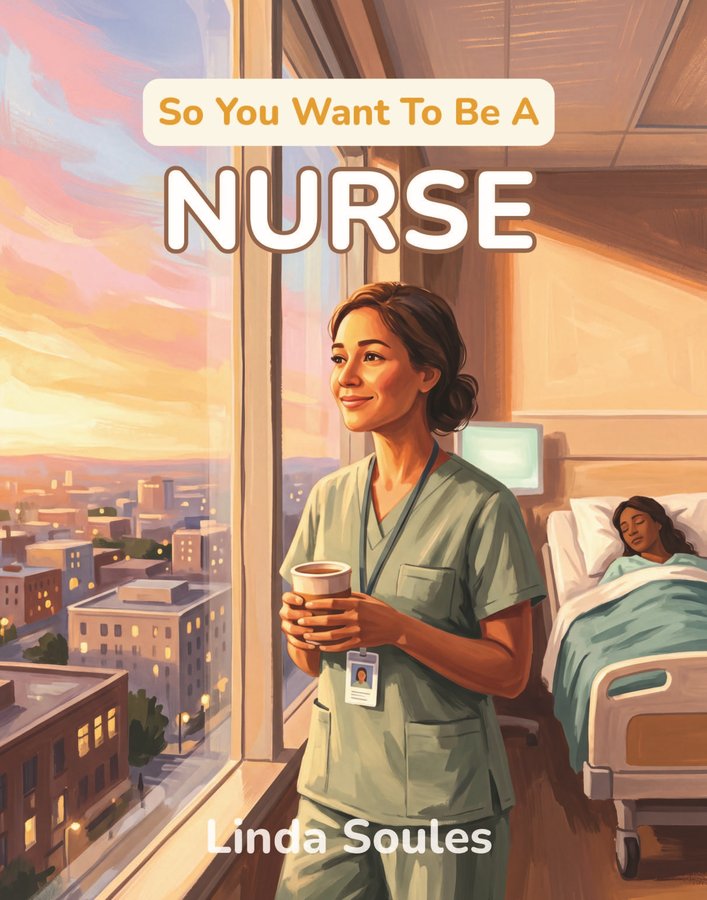
So You Want To Be A Nurse
by Linda Soules
MOST CURIOSITY-SPARKING BOOKY
The judge's reasoning
This book earns its Booky on substance. Most career books for kids hand over a list of duties and a stethoscope. Linda Soules builds an argument instead: a nurse's real work is noticing, and the whole book keeps coming back to that. It opens with it ("Nurses stay... usually the first to notice when something changes"), shows it in Maya's inhaler lesson and in the 11:30 AM sepsis catch, and closes by turning it into homework, with the observation journal and the pulse-counting exercises in "What You Can Do to Prepare Right Now."
The evidence earns its place too. The staffing statistic, Florence Nightingale's wedge charts, and Dee O'Hara at NASA all support the claim. Soules also tells children the hard parts honestly: workplace violence, burnout, crying in the car on the way home. She never lets that tip into gloom, because the same pages carry warmed blankets, a pet owl named Athena, and an IV pole named Steve who gets a sticker.
The structure is sturdy and kid-friendly: short, titled sections, a "Day in the Life" timeline, a "Talk Like a Nurse" glossary, and a biography gallery. That gallery includes Susie Walking Bear Yellowtail, Mary Eliza Mahoney, Luther Christman and Ildaura Murillo-Rohde, and it never tells young readers that nursing was always open to everyone. Teach-back is the book's best practical idea, and a child can use it by dinnertime. It changes one specific thing about a reader's week, which is the highest standard I know for non-fiction.

Judged by Arthur Beaumont — Non-Fiction · Memoir · Business · Self-Help
"A good non-fiction book changes one specific thing about your week."
Supporting passages
"Machines help, but a nurse's best tools are trained eyes, ears, and even a nose."
States the book's central argument in one plain line that a child can repeat and test for themselves.
"The most surprising thing about nursing may be how much of a hospital depends on nurses."
A classic children's-nonfiction move: a surprising claim, then concrete numbers and vivid comparisons to back it up.
"Many nurses admit they sometimes cry in the car on the way home, and they say that is part of caring."
Tells young readers an emotional truth without sugarcoating it and without frightening them.
Per-axis rubric scores
Every Booky-winning book is scored across all ten craft axes. The award category comes from the top axis; a second axis at or above 75 appears as secondary recognition.
Find out what your book does best.
Submit your book today. Get a real, honest, category-specific Booky — or every dollar back.
Submit Your Book → Screen Another Book