
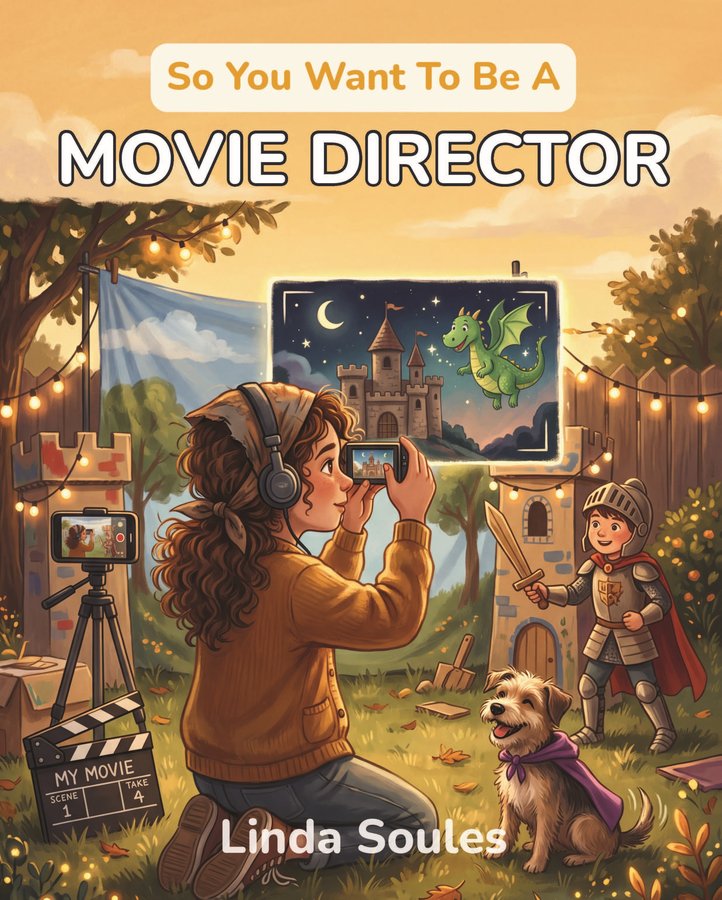
So You Want To Be A Movie Director
by Linda Soules
MOST VIVID WORLD FOR YOUNG READERS BOOKY
The judge's reasoning
A good non-fiction book changes one specific thing about your week, and this one hands a child a phone, a toy, and a plan for Saturday. Linda Soules has built a guide that makes the film set feel like a place you could walk into. The "Day in the Life" chapter is the proof: a 6:00 AM call sheet, a goat that eats a prop treasure map on take four, an actress who laughs and ad-libs "Well, now we'll have to find the rest," and a painful 3:00 PM cut when the light runs short. That one imagined day teaches blocking, coverage, dailies, and magic hour without a single dull definition.
The lived texture is everywhere. Ben Burtt makes lightsaber hum from a projector and a TV set. Pixar keeps pet rats around for Ratatouille. Spielberg's broken shark, Bruce, becomes a lesson that "a broken shark or a jammed camera" can be "a clue that something better might be hiding nearby." The Kuleshov experiment, with the same calm face beside soup, a funeral, and a sofa, is explained so cleanly that the book dares the reader to test it with a friend.
The book also tells children the truth. It covers the twelve-hour days, development hell, studios replacing directors, and the 2025 figure of women directing only about 8 percent of top films, then points to mentorships and grants. The profiles of Guy-Blaché, Ray, Miyazaki, Nelson, and DuVernay show real people who started as secretaries, ad designers, and publicists. The closing "Try It" activities and preparation list turn curiosity into action by next weekend.

Judged by Arthur Beaumont — Non-Fiction · Memoir · Business · Self-Help
"A good non-fiction book changes one specific thing about your week."
Supporting passages
"On take four, the goat wanders into the shot and eats a corner of the treasure map. Everyone freezes. Then the young actor playing the girl laughs, picks up the map, and says, "Well, now we'll have to find the rest." It's not in the script. It's perfect. You keep it."
A single invented set day lets the reader live the job, and the goat gag quietly teaches flexibility before the book names it as a quality.
"Great directors treat a broken shark or a jammed camera as a clue that something better might be hiding nearby."
The book turns a pile of anecdotes into a transferable lesson a child can apply to their own failed project.
"Filmmakers like to say that a movie gets made three times: once when it's written, once when it's filmed, and once when it's edited."
This simple frame organizes pre-production, filming, and post-production into a throughline a young reader can hold onto.
Per-axis rubric scores
Every Booky-winning book is scored across all ten craft axes. The award category comes from the top axis; a second axis at or above 75 appears as secondary recognition.
Find out what your book does best.
Submit your book today. Get a real, honest, category-specific Booky — or every dollar back.
Submit Your Book → Screen Another Book