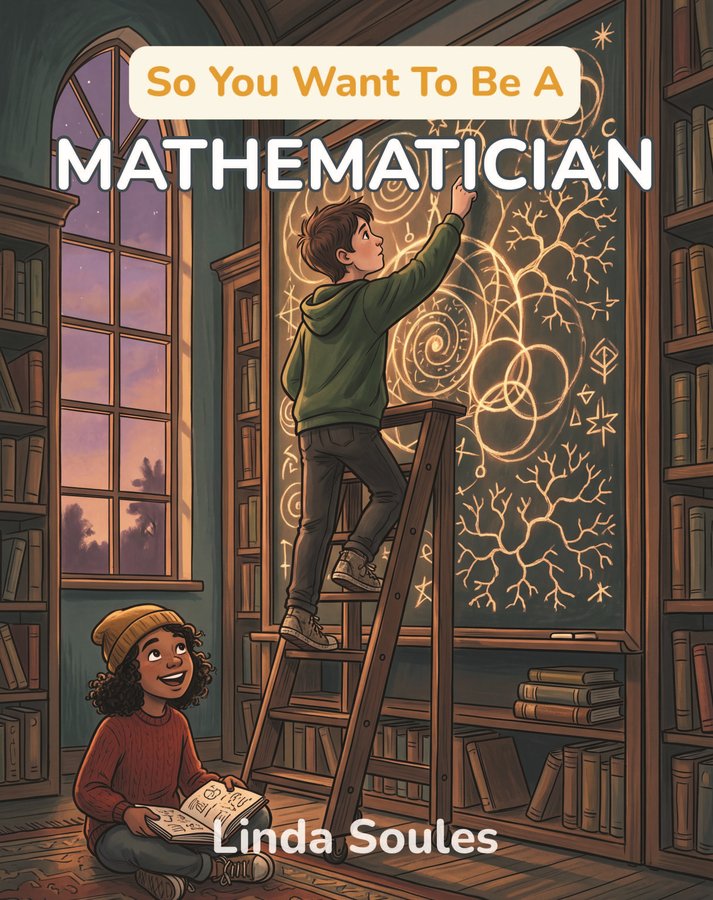
So You Want To Be A Mathematician
by Linda Soules
MOST INSPIRING KIDS' BOOK BOOKY
The judge's reasoning
This book opens with a trick and then makes good on it. Before we're told what a mathematician is, we're handed a certainty nobody could count their way to: somewhere in New York, two people have exactly the same number of hairs. Buckets, pigeons, one "very annoyed pigeon," and a child understands the pigeonhole principle and, more importantly, why proof beats checking. Linda Soules never lets that thesis go. The circle-and-dots puzzle where the pattern 2, 4, 8, 16 breaks at 31 sends the reader to a pencil to be fooled personally, and the book returns to it later, in "Honest Self-Checking."
What earns the top mark is how much real mathematics this book trusts a ten-year-old with. Euclid's infinitude-of-primes argument is laid out in full, with 30,031 = 59 × 509 as the worked example. Homer Simpson's wrong Fermat equation is dismantled with nothing but digit sums and divisibility by 3. The cake-cutting joke in "A Day in the Life" turns out to be a real research problem with dates attached. Nothing is condescended to, and nearly every page ends in something a kid can do.
The human stories are chosen with care. Noether teaching under a male colleague's name, Ramanujan wiping his slate with his elbow, June Huh the high-school dropout who became a Fields medalist, and the live goose Mazur owed Per Enflo all show mathematics as a human, stubborn, funny enterprise. The author's closing note ties it together: a proof doesn't care who wrote it. For a ten-year-old who has been told they're not a "math person," that is a generous thing to say, and the book has earned it.

Judged by Brooke Hayes — Reader-at-Large · Cross-Genre · Emerging Voices
"Every book is the only book for somebody."
Supporting passages
"A pattern held for four cases in a row and then broke. Four is not enough. Four hundred would not be enough either. That is why a mathematician is not satisfied until there is a proof."
The book's core idea, why proof matters, is delivered through a puzzle the reader has just been fooled by.
"Thirty-six years went by before a young Swedish mathematician named Per Enflo solved it in 1972. Mazur, by then an old man, kept his promise. At a ceremony in Warsaw, broadcast on national television, he handed Enflo a live goose."
A perfect career-book moment: a surprising, true, memorable anecdote that makes the profession feel human and fun.
"There is no such thing. There are only people who stayed stuck a little longer than was comfortable, until the problem finally gave way."
The author's note speaks directly to the child who has been told they aren't a 'math person,' and it lands.
Per-axis rubric scores
Every Booky-winning book is scored across all ten craft axes. The award category comes from the top axis; a second axis at or above 75 appears as secondary recognition.
Find out what your book does best.
Submit your book today. Get a real, honest, category-specific Booky — or every dollar back.
Submit Your Book → Screen Another Book