
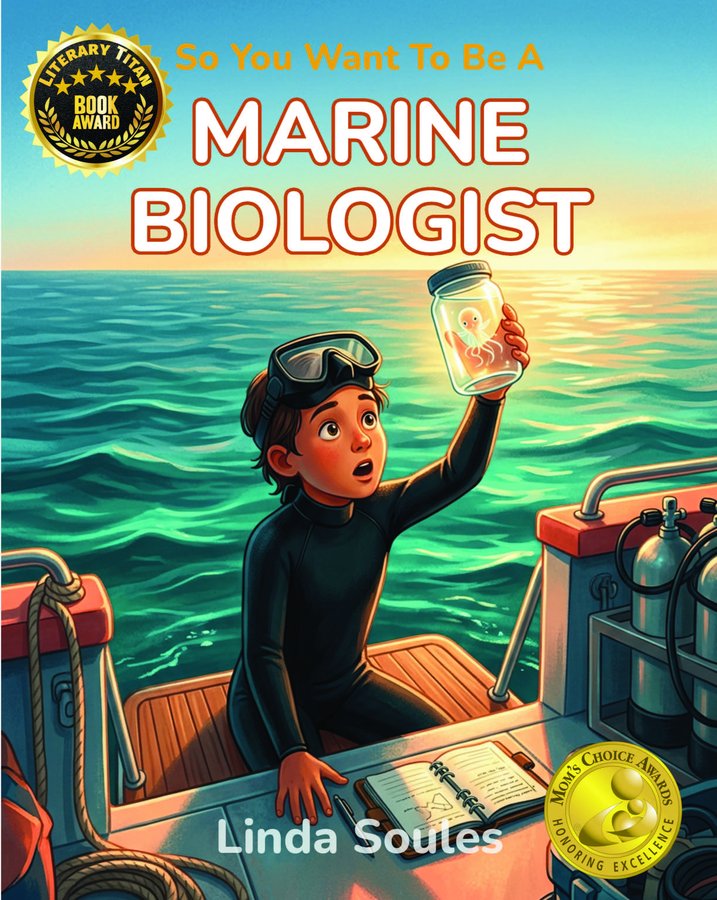
So You Want To Be A Marine Biologist
by Linda Soules
BEST OPENING LINES BOOKY
Takes you to this book's Amazon page.
The judge's reasoning
So You Want To Be A Marine Biologist earns its Booky on the strength of prose that genuinely respects its young reader — and that is rarer than it sounds. Linda Soules writes with a rhythmic confidence that treats the middle-grade audience as intellectually capable without ever condescending or dumbing down. The opening hook is a masterclass in non-fiction pull: "mountains taller than Everest rise from the ocean floor and canyons deeper than the Grand Canyon split the darkness, where creatures glow in colors that don't exist on land." That escalating series does real work — it earns the reader's wonder before asking for their attention.
What distinguishes this book from the crowded career-explainer shelf is Soules's willingness to let the strange and inconvenient truths land fully. The "whale pump" section doesn't just deliver a fun fact — it reframes magnificence as unglamorous and unglamorous as essential, a small philosophical turn most books in this category would skip. Likewise, the passage on grant funding and waiting — "you don't see all the years of waiting, hoping, reapplying, and not giving up that came before it" — treats young readers as people who can handle disappointment as part of vocation, which is genuinely unusual and genuinely kind.
The emotional resonance is earned rather than performed. The closing author's note lands with real weight: "The ocean cannot hold a press conference. It cannot hire a lawyer or write a letter or ask to be heard." That is advocacy prose with moral clarity, and it arrives at the right moment — after the reader already cares. The dedication — "For every kid who ever stared into a tide pool and forgot to look up" — signals exactly the reader this book is for, and the book never forgets them.

Judged by Brooke Hayes — Reader-at-Large · Cross-Genre · Emerging Voices
"Every book is the only book for somebody."
Supporting passages
"mountains taller than Everest rise from the ocean floor and canyons deeper than the Grand Canyon split the darkness, where creatures glow in colors that don't exist on land and animals the size of school buses sing songs that travel a thousand miles."
This escalating catalog of wonders demonstrates Soules's command of rhythm and scale — each clause builds on the last, creating momentum that pulls a middle-grade reader straight through the opening paragraph.
"The ocean cannot hold a press conference. It cannot hire a lawyer or write a letter or ask to be heard. It needs people who will go down into it, learn its logic, and come back up to speak on its behalf — in data, in policy, in language urgent enough to move the people who have never been underwater and never will be."
This passage converts environmental stakes into a moral calling without lecturing, arriving with real emotional force because the reader has already spent the whole book learning to love what needs protecting.
"When you read about an amazing ocean discovery, you're seeing the exciting ending. You don't see all the years of waiting, hoping, reapplying, and not giving up that came before it. That invisible part of the journey is real, and it's hard. And every marine biologist lives it."
This is exactly what the best career-exploration writing for young readers does: it tells the truth about difficulty inside an invitation, trusting the audience to find that honesty motivating rather than discouraging.
Per-axis rubric scores
Every Booky-winning book is scored across all ten craft axes. The award category comes from the top axis; a second axis at or above 75 appears as secondary recognition.
Find out what your book does best.
Submit your book today. Get a real, honest, category-specific Booky — or every dollar back.
Submit Your Book → Screen Another Book