
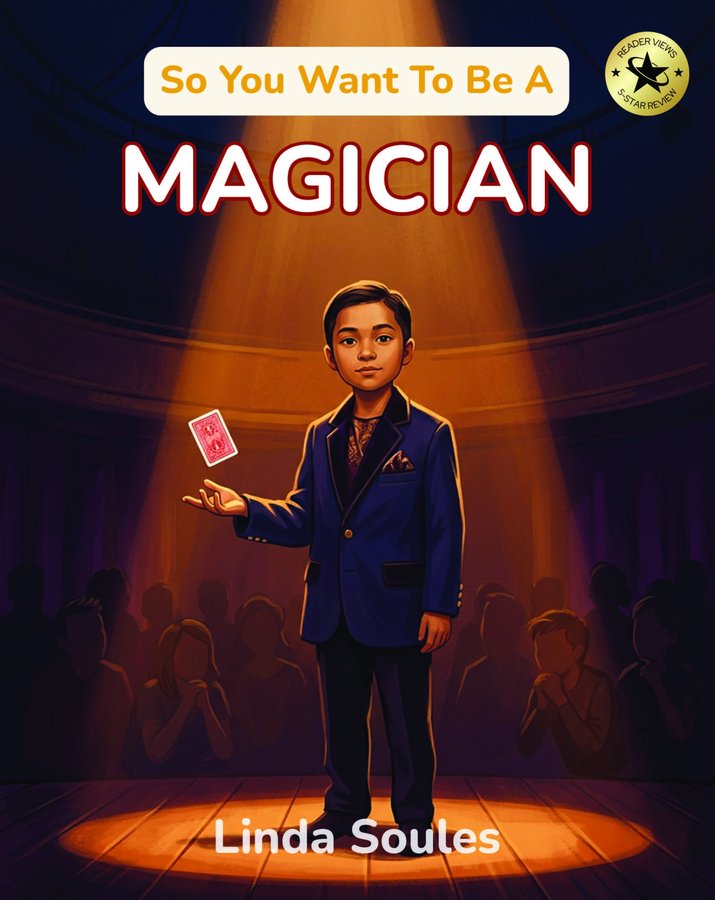
So You Want To Be A Magician
by Linda Soules
MOST EMOTIONALLY HONEST BOOKY
Takes you to this book's Amazon page.
The judge's reasoning
So You Want To Be A Magician does something most career-exploration books for children don't attempt: it earns the emotional register it aims for. Linda Soules writes about wonder as though she actually believes in it, and that conviction comes through on every page.
The standout moment — and it's genuinely affecting — is the passage about performing magic for someone living with Alzheimer's. Soules writes: "Wonder, it turns out, is stronger than forgetting." That line lands because the book has spent fifty pages building to it. By the time we arrive at the hospital bed and the laugh that "escaped before they could stop it," we understand exactly what magic is for. It's not a detour into sentimentality; it's the thesis, revealed.
The prose itself is doing real work throughout. The opening section's double-secret structure — "Here's the first secret: it is impossible. But here's the second secret, and this one matters more: the feeling is real" — models the very misdirection it's describing. Soules writes the way a good magician performs: she leads your attention one direction, then reveals the real thing was somewhere else the whole time.
The "A Day in the Life" section is structured with genuine economy — "The almost-didn't goes back into practice tomorrow morning" is a single sentence that conveys years of professional discipline. The "Note From the Author" closes with an ethical dimension — "The magician deceives in order to give. The deception is the gift" — that trusts middle-grade readers with a genuinely complex idea.
For the kid who has ever stood in front of a mirror practicing one card trick, this book sees them completely.

Judged by Brooke Hayes — Reader-at-Large · Cross-Genre · Emerging Voices
"Every book is the only book for somebody."
Supporting passages
"Wonder lives deeper than memory. It lives in a part of the brain that some diseases cannot reach — a place that stays bright even when other lights go dim. And a good magician, with nothing more than a deck of cards and years of quiet practice, can find it every time."
This is the emotional climax of the book — a genuinely moving claim about what magic is actually for, earned by everything that precedes it.
"Here's the first secret: it is impossible. Coins don't vanish. Cards don't read minds. Nothing a magician does is real. But here's the second secret, and this one matters more: the feeling is real."
The opening section structurally mirrors the misdirection it's explaining — a piece of craft writing that demonstrates its subject at the sentence level.
"The magician deceives in order to give. The deception is the gift, and the gift is wonder — the rarest and most easily lost feeling a person carries through life. The real craft of magic is not fooling people. It is taking care of the part of them that still wants to believe."
A sophisticated ethical argument delivered clearly enough for a ten-year-old and with enough weight to land for an adult reading alongside them.
Per-axis rubric scores
Every Booky-winning book is scored across all ten craft axes. The award category comes from the top axis; a second axis at or above 75 appears as secondary recognition.
Find out what your book does best.
Submit your book today. Get a real, honest, category-specific Booky — or every dollar back.
Submit Your Book → Screen Another Book