
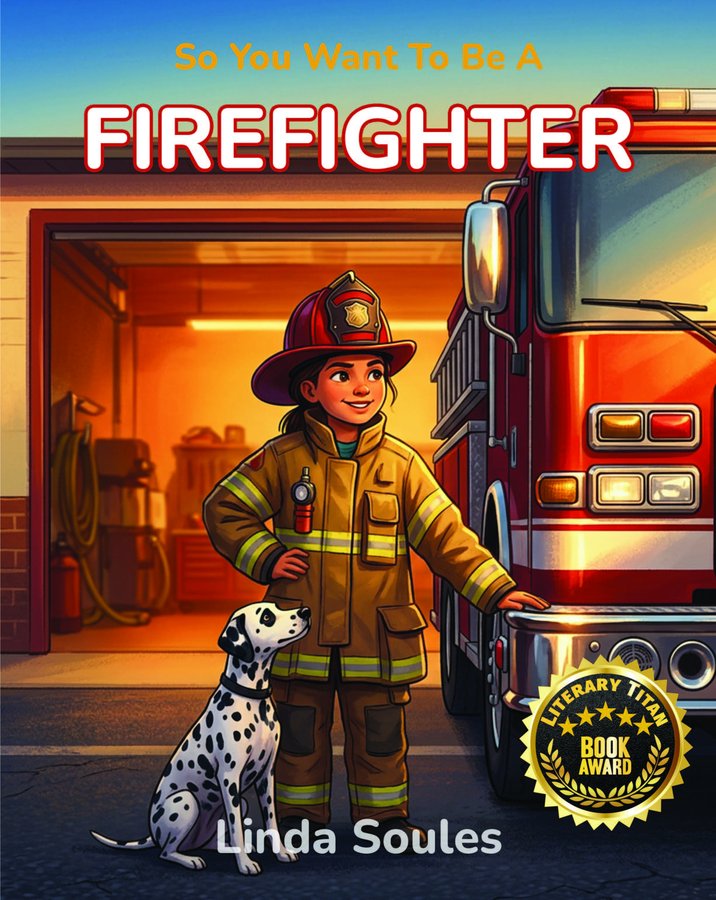
So You Want To Be A Firefighter
by Linda Soules
MOST SLOW-BURN ROMANCE BOOKY
Takes you to this book's Amazon page.
The judge's reasoning
So You Want To Be A Firefighter knows exactly who it's for and never wavers from them. Linda Soules has found the voice that middle-grade career nonfiction almost never achieves: she's not dumbing down, not puffing up, and not handing a child a brochure. She's having a conversation.
The genre execution here is sharp throughout. The chapter structure — moving from the romantic fantasy of the job (the shiny pole, the screaming siren) to the genuine texture of it (engineered wood beams failing in four minutes, the grief that doesn't leave) — is exactly right for a reader aged 10-13 who is ready to be taken seriously. The section on why modern homes burn more dangerously than old ones is the kind of counterintuitive, specific, memorable fact that makes a kid feel like they've been trusted with insider knowledge. That's the currency this genre runs on, and Soules spends it well.
The prose itself earns a strong secondary mention. The opening alarm sequence — "Your boots are already tucked inside your pants, stacked beside the rig, waiting for this exact moment" — is sensory and precise without being showy. The author's note closing the book, with its meditation on the firefighter's promise, lifts above functional nonfiction into something a child will remember. The line "carrying losses that don't leave you and going back in anyway, because the next family didn't cause the last one's grief" is genuinely fine writing — the kind a curious twelve-year-old will feel before they can fully parse it, which is exactly how good prose works on young readers.

Judged by Brooke Hayes — Reader-at-Large · Cross-Genre · Emerging Voices
"Every book is the only book for somebody."
Supporting passages
"Here's something real firefighters learn early: a house fire in a brand-new house can be more dangerous than a fire in a 100-year-old house. That sounds backward. It isn't."
This is the book doing what middle-grade nonfiction should do at its best — delivering a counterintuitive, specific truth in a voice that makes the reader feel trusted rather than lectured.
"carrying losses that don't leave you and going back in anyway, because the next family didn't cause the last one's grief"
A sentence that earns its emotional weight through precision rather than sentiment — the kind of writing that works on young readers at the feeling level before the cognitive level catches up.
"The look on a person's face when they realize they're safe — that they're going to be okay — is something a firefighter never, ever forgets."
Simple, concrete, and earned by the surrounding context; this is the moment the book's warmth lands cleanly for its intended reader.
Per-axis rubric scores
Every Booky-winning book is scored across all ten craft axes. The award category comes from the top axis; a second axis at or above 75 appears as secondary recognition.
Find out what your book does best.
Submit your book today. Get a real, honest, category-specific Booky — or every dollar back.
Submit Your Book → Screen Another Book