
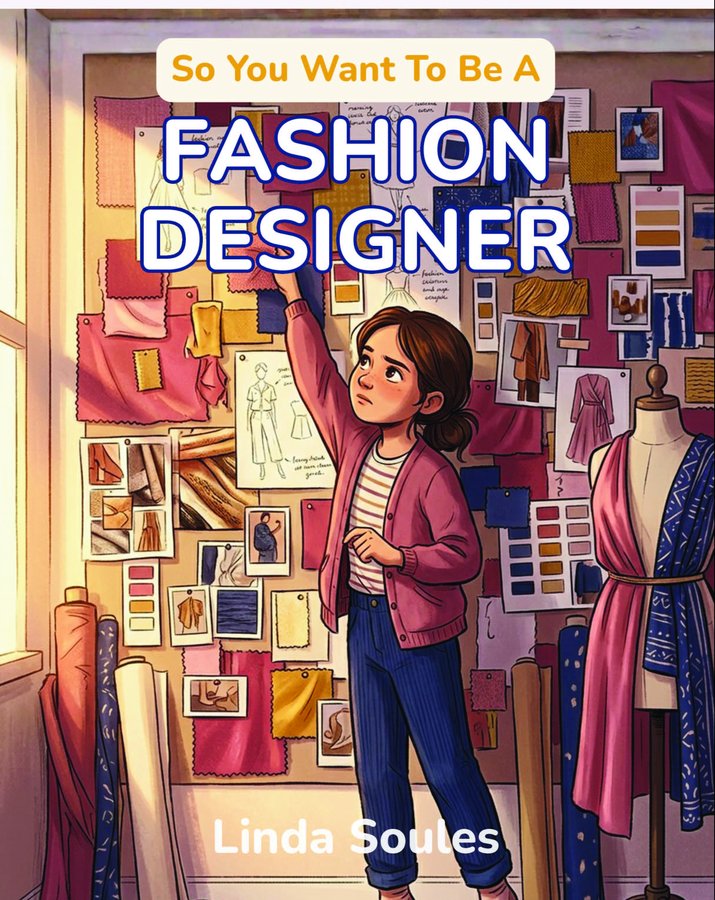
So You Want To Be A Fashion Designer
by Linda Soules
BEST LIFE LESSON BOOKY
Takes you to this book's Amazon page.
The judge's reasoning
So You Want To Be A Fashion Designer does something most career-exploration books for kids fumble entirely: it tells the truth. Not the glossy, runway-only version, but the real shape of a vocation — its physics, its ethics, its emotional weight, and its quiet power over how people feel about themselves.
The book's central argument — that "clothing is the only art form you wear" — is stated early and then earned on every page. Soules doesn't stop at "someone designed your T-shirt." She goes further: "The fitting room is the most emotional room in the world. Designers have watched people cry there, not because the clothes don't fit, but because, for the first time, they do." That's not a fact a child will forget.
The prose itself is the engine. Soules writes in sentences that have genuine rhythm and specificity: "Cotton breathes but wrinkles. Silk drapes like water but stains. Wool insulates but can itch." This isn't filler — it's exactly the kind of tactile, mnemonic prose that sticks in a young reader's mind and teaches while it moves. The day-in-the-life section is structured with cinematic economy, and the designer biographies — particularly the Issey Miyake entry — handle genuinely difficult history (Hiroshima, loss, survival) with a gravity that respects the middle-grade reader without overwhelming them.
The book also models something rare in the genre: intellectual honesty about the hard parts, the sustainability crisis, copied designs, the punishing seasonal pace. It trusts children with complexity. That trust is the book's defining quality, and it earns its place on any shelf next to the best career nonfiction for young readers.

Judged by Brooke Hayes — Reader-at-Large · Cross-Genre · Emerging Voices
"Every book is the only book for somebody."
Supporting passages
"Someone who has spent a whole life being told their body is wrong puts on a garment that says the opposite. Your body is exactly right. We made this for you. The moment they stop wishing they were someone else and quietly think, there I am, is the moment fashion does what it's designed for."
This passage crystallizes the book's core argument — that fashion design is fundamentally an act of human dignity — in language a middle-grade reader can feel before they can fully articulate.
"Cotton breathes but wrinkles. Silk drapes like water but stains. Wool insulates but can itch. Linen cools in heat and softens beautifully with age. Denim fades with wear, recording the life of the person in it."
The staccato rhythm and sensory precision here demonstrate exactly how strong nonfiction prose for young readers should work: memorable, concrete, and cumulative.
"He survived, and for most of his life he chose not to talk about it. Instead, he poured himself into making things that were new and full of life... He spent his career proving that clothing can be art, and that something beautiful can be built even by a person who has seen the worst the world can do."
The Issey Miyake biography handles historical trauma with restraint and grace, landing an emotional note that elevates the book well beyond standard career-guide territory.
Per-axis rubric scores
Every Booky-winning book is scored across all ten craft axes. The award category comes from the top axis; a second axis at or above 75 appears as secondary recognition.
Find out what your book does best.
Submit your book today. Get a real, honest, category-specific Booky — or every dollar back.
Submit Your Book → Screen Another Book