
So You Want To Be A Deep Sea Diver
by Linda Soules
BEST OPENING LINES BOOKY
Takes you to this book's Amazon page.
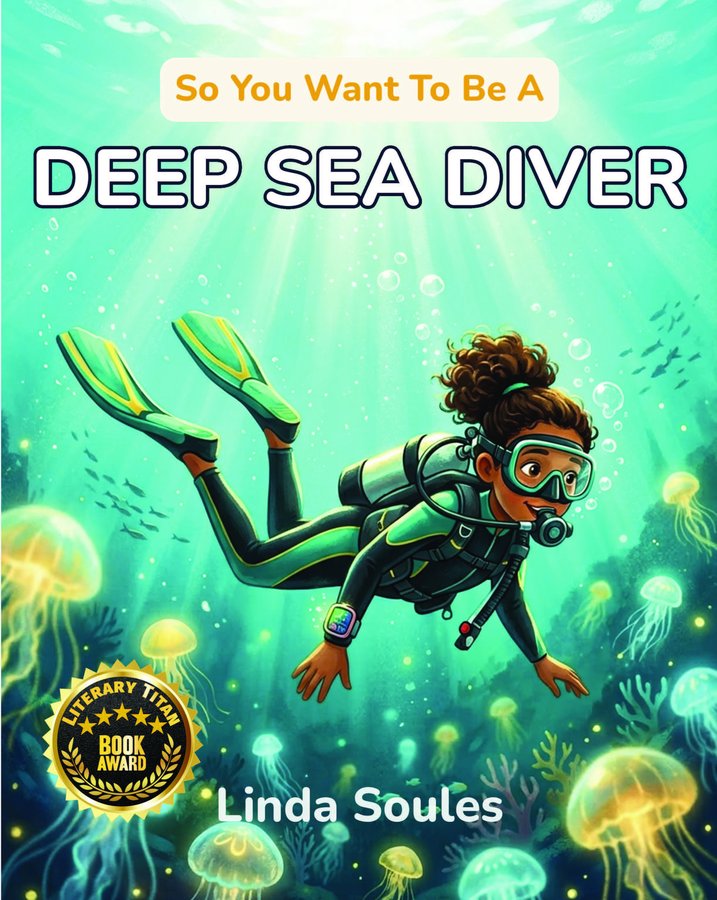
The judge's reasoning
Linda Soules writes nonfiction for children the way the best magazine journalists write for adults: with precision, rhythm, and the understanding that a good sentence does more than convey information — it makes a reader feel the thing being described. The opening pages of So You Want To Be A Deep Sea Diver establish this immediately. "Down to where the flashlight you carry is the brightest thing for miles. Down to where the small tank on your back is the only reason you can breathe at all." That anaphora isn't decorative; it's doing the work of descent, carrying the reader down incrementally the way a diver descends a line.
Soules is equally skilled at the punchy reversal — the rhetorical move of "here's what people think / here's what actually happens" that structures the book's second chapter and earns every word that follows it. The saturation diving explanation, with its airlock meals and helium-squeaked voices, is the kind of specific, strange, and perfectly calibrated detail that middle-grade readers will underline and read aloud to someone else.
The world-building here is the world-building of a very good explainer: the aphotic zone rendered not as a definition but as an atmosphere, the "liquid light" of bioluminescence described so vividly it functions almost as a scene. The glossary and "Day in the Life" sections do structural heavy lifting without feeling like homework. Throughout, Soules treats her readers as people who deserve the real thing — the physics, the history, the fear, the wonder — and that respect is evident on every page.

Judged by Brooke Hayes — Reader-at-Large · Cross-Genre · Emerging Voices
"Every book is the only book for somebody."
Supporting passages
"Down to where the flashlight you carry is the brightest thing for miles. Down to where the small tank on your back is the only reason you can breathe at all. Every minute you spend down there is a minute you earned — through training, through patience, through learning the rules of a world humans only get to visit."
The anaphora enacts the sensation of descent, and the final clause reframes the entire premise of the book — the deep ocean as a world earned, not simply entered — in one clean sentence.
"Turn off your dive light in the dark water. Wave your hand. And watch the ocean light up with millions of microscopic organisms, each producing a flash of cold blue light when disturbed. Your hand leaves a trail of stars. Your fins kick up galaxies. You are swimming through liquid light, in absolute darkness, surrounded by creatures you never see during the day, and the entire ocean is glowing."
This passage builds an entire sensory world in under a hundred words, moving from instruction to wonder in a way that makes bioluminescence feel like something the reader has almost already experienced.
"That's why every safety protocol in diving was written down by someone who learned it the hard way. The rules aren't suggestions; they're letters from divers who came before, telling you what to watch for and how to come home. Following them is how you join that chain."
Soules turns procedural discipline into something genuinely moving — the idea of rules as inherited wisdom and community membership reframes safety culture as belonging, a theme with reach well beyond this particular career.
Per-axis rubric scores
Every Booky-winning book is scored across all ten craft axes. The award category comes from the top axis; a second axis at or above 75 appears as secondary recognition.
Find out what your book does best.
Submit your book today. Get a real, honest, category-specific Booky — or every dollar back.
Submit Your Book → Screen Another Book