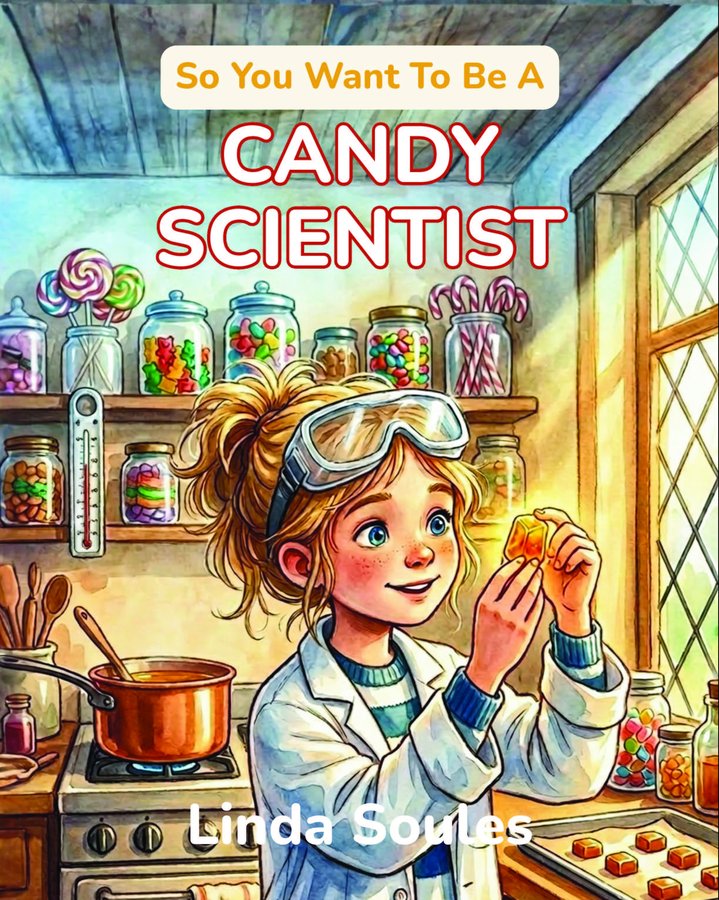
So You Want To Be A Candy Scientist
by Linda Soules
MOST CURIOSITY-SPARKING BOOKY
Takes you to this book's Amazon page.
The judge's reasoning
So You Want To Be A Candy Scientist does something genuinely difficult: it treats a subject most adults dismiss as frivolous with the full seriousness it deserves, and in doing so argues — quietly but insistently — that rigor and delight are not opposites. The book's central thesis lands early and holds all the way through: "The difference between them is not what goes in. It is what the scientist does to it." That reframe — candy as a controlled experiment rather than a happy accident — gives the whole book intellectual spine.
The substance here is real and specific. The explanation of amorphous versus crystalline candy states, the six cocoa-butter crystal forms and why only Form V matters, the saffron caramel that fails because the flavor goes in "too early" and succeeds when added to warmth rather than heat — these are not dumbed-down approximations. They are accurate, and they are presented with the confidence that a middle-grade reader can handle them. The author's note at the end crystallizes the book's argument beautifully: "To insist that a moment of delight deserves the same care as anything else is not frivolous at all. It is a quiet way of saying that everyday human happiness matters and is worth getting right." That is a real idea, earned by the pages before it.
The prose earns its own recognition. Sentences like "A candy scientist learns to read sugar the way a musician reads music" and "The chew is architecture" are calibrated for a child's imagination without being childish. The "Day in the Life" section grounds abstraction in a concrete 8 AM–5:30 PM arc that makes the career feel livable, not just admirable. For a book designed to spark genuine career curiosity, that specificity is the whole point — and it delivers.

Judged by Brooke Hayes — Reader-at-Large · Cross-Genre · Emerging Voices
"Every book is the only book for somebody."
Supporting passages
"To take something that small and that universal and bring real rigor to it, to insist that a moment of delight deserves the same care as anything else, is not frivolous at all. It is a quiet way of saying that everyday human happiness matters and is worth getting right."
This passage articulates the book's thesis with clarity and warmth, making a genuine philosophical argument accessible to young readers without condescension.
"If you add saffron to the heat, it dies, but if you add it to the warmth, it blooms. That is the lesson."
A single concrete example compressed into a memorably balanced sentence — the kind of prose rhythm that lodges in a child's memory and makes science feel like craft.
"Every candy you eat is a science experiment that has already been performed. The candy scientist is simply the person who paid close attention."
This closing reframe recontextualizes every candy a child has ever eaten as evidence of science, making the abstract tangible and the career aspirational.
Per-axis rubric scores
Every Booky-winning book is scored across all ten craft axes. The award category comes from the top axis; a second axis at or above 75 appears as secondary recognition.
Find out what your book does best.
Submit your book today. Get a real, honest, category-specific Booky — or every dollar back.
Submit Your Book → Screen Another Book