
BookyAwards · 2026
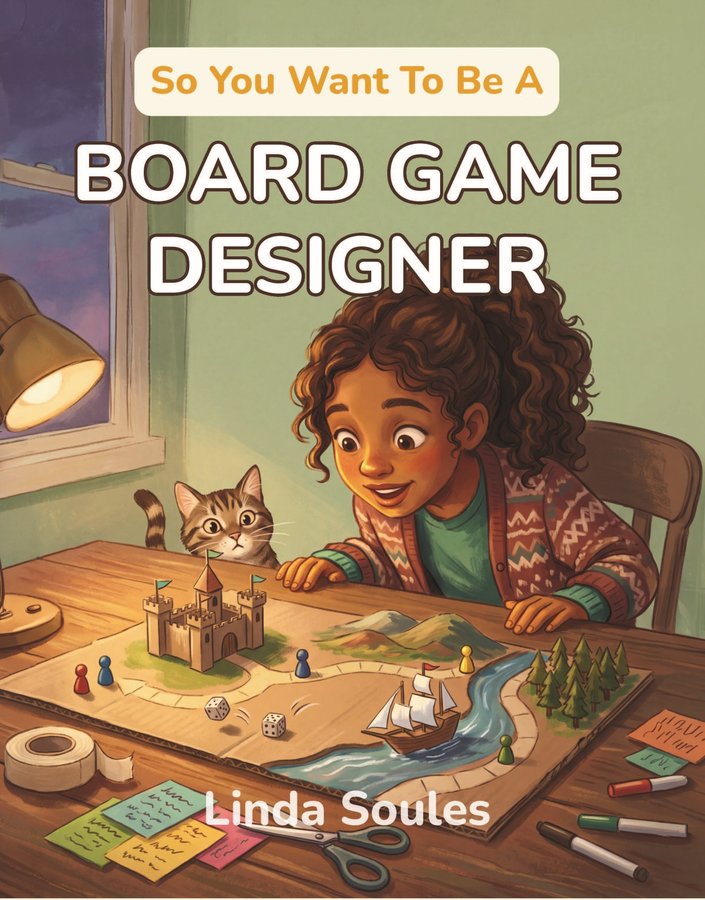
So You Want To Be A Board Game Designer
by Linda Soules
Best Conversation-Starter for Families Booky
The citation
The judge's reasoning
A good non-fiction book changes one specific thing about your week, and this one hands a kid a to-do list they can start tonight: grab index cards, invent one house rule, shut up and watch people play.
What earns the Booky is how honestly the book treats the job. Linda Soules doesn't sell a fantasy. She tells young readers that royalties run about 5 to 8 percent, so a $20 game might earn a designer roughly $1, and that 3,000 copies can mean about $3,000 for two-plus years of work. She admits that "hearing someone criticize your game can feel a little like hearing someone call your puppy ugly," and then gives the remedy: take notes and say "thank you." That candor, delivered without a trace of condescension, is rare in career books for kids.
The substance is real and specific. The blind playtest, in which strangers learn from the rulebook while the designer sits silent, is paired with a concrete reason: "Write 'move forward three spaces,' and someone will ask whether the space you're standing on counts." The "Overheard at Playtest Night" spread translates complaints into design diagnoses (analysis paralysis, kingmaker, a card that's secretly a bully), vocabulary a ten-year-old can use at the next family game night.
The biographical sketches (Lizzie Magie, Leslie Scott, Klaus Teuber, Seiji Kanai, Elizabeth Hargrave, Omari Akil) are chosen with care. They show designers from many backgrounds and countries, and none of them reads like a plaque. The "A Day in the Life" section, with its 12-year-old pearl-hoarding playtester who beats the adults, makes the work feel alive.
The humor is dry and well timed (a cat sitting on the giant squid, a sticky-card cheese-puff mystery), and the activities close the loop: kids finish the book ready to build.
From the book
Supporting passages
"Write "move forward three spaces," and someone will ask whether the space you're standing on counts. Good designers answer that question before anyone has to ask it."
"If a store pays $20 for a copy, the designer might get about $1."
"Hearing someone criticize your game can feel a little like hearing someone call your puppy ugly. Designers learn to resist the urge to argue, take notes, and say "thank you.""
The scorecard
Per-axis rubric scores
Every Booky-winning book is scored across all ten craft axes. The award category comes from the top axis; a second axis at or above 75 appears as secondary recognition.
- Prose & Style 84
- Characterization 80
- Dialogue 76
- Plot & Structure 85
- World-Building 88
- Originality 80
- Emotional Resonance 78
- Theme & Substance AWARDED 90
- Genre Execution SECONDARY RECOGNITION 89
- Marketability & Hook 86
Scores out of 100
Find out what your book does best.
Submit your book today. Get a real, honest, category-specific Booky — or every dollar back.
