
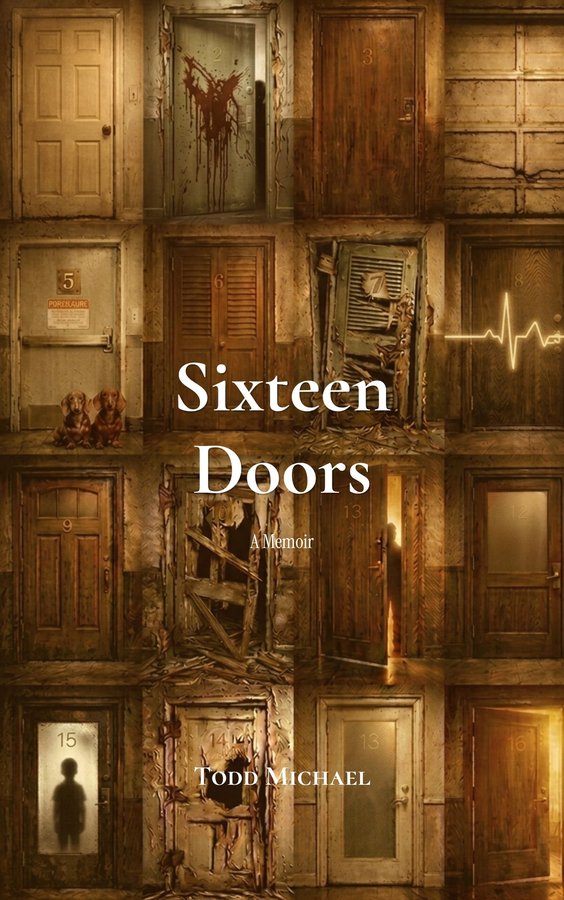
Sixteen Doors
by Todd Michael
MOST IMMERSIVE SETTING BOOKY
Takes you to this book's Amazon page.
The judge's reasoning
The strength here is architectural, literally and structurally. Todd Michael has built his memoir on a genuinely clever conceit — sixteen houses as sixteen chapters of psychological development — and the book earns that conceit through sheer sensory specificity. He doesn't just tell you Discovery Lane was a turning point; he tells you he planted eight queen palms and three king palms, describes how "the queens framed the backyard" while "the kings grounded the front yard," and lets that small piece of landscaping stand in for the tension between ambition and stability running through the whole book. That's the kind of concrete, physical detail that makes a lived world feel real on the page rather than reported.
The houses accumulate real texture — the upside-down crown moulding at Rutgers, the glued-down decor in the Palm Springs model home, the wallpaper Dave calls "terrible" thirty seconds after installation. These aren't just anecdotes; they're doing structural work, marking each door as a distinct emotional register (survival, momentum, confidence, breath) while staying anchored in the physical stuff of a house — carpet, paint, popcorn ceilings, pool tile.
The hook is strong and marketable: a real estate memoir that uses the house-as-self metaphor without over-explaining it, aimed squarely at readers who built something that looked solid from outside and wasn't. The Mike McCready detail is the kind of concrete, verifiable color that gives a self-published memoir unexpected credibility and a pull-quote. Where the book softens is in dialogue (often functional, not distinctive) and in leaning on abstraction ("breath," "stillness," "arrival") rather than scene when the emotional stakes get highest — but the world it builds, door by door, is genuinely vivid.

Judged by Arthur Beaumont — Non-Fiction · Memoir · Business · Self-Help
"A good non-fiction book changes one specific thing about your week."
Supporting passages
"I planted eight queen palms along the property line — tall, elegant, swaying like dancers in the wind... Then I added three king palms — thicker, stronger, anchoring the yard with permanence."
Concrete, sensory detail doing double duty as emotional metaphor — this is the book's structural trick working at its best.
"This book isn't about real estate, though real estate is the language I used to build my adulthood."
A clean, quotable framing line that sells the book's premise in a single sentence.
"Fifteen more doors would come after this one. Fifteen chances to build, to fail, to rise, to learn who I was when I wasn't running from anything."
The door-count device gives the memoir forward momentum and a countdown structure readers can track.
Per-axis rubric scores
Every Booky-winning book is scored across all ten craft axes. The award category comes from the top axis; a second axis at or above 75 appears as secondary recognition.
Find out what your book does best.
Submit your book today. Get a real, honest, category-specific Booky — or every dollar back.
Submit Your Book → Screen Another Book