
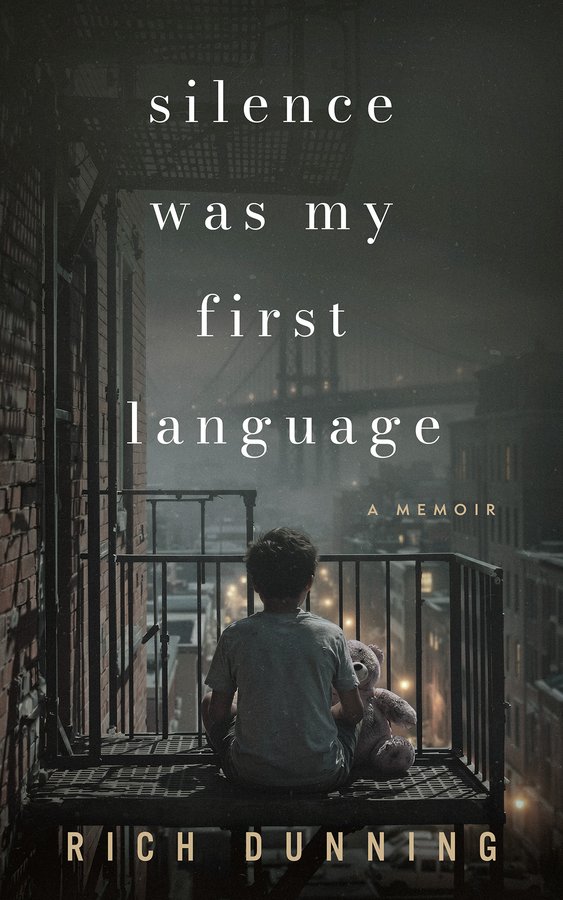
silence was my first language
by rich dunning
BEST INTERNALLY CONSISTENT WORLD BOOKY
Takes you to this book's Amazon page.
The judge's reasoning
Rich Dunning's Silence Was My First Language earns its Booky on the axis of World-Building — or more precisely, on the memoir's power to render a vanished world so completely that the reader's skin registers it. This is a Bronx of the early 1970s and '80s conjured through sensation rather than nostalgia: the avocado-green refrigerator whose "motor grinding like an old man's last breath" fights the cold it cannot beat; the stairwell to Dunning's father's apartment in Soundview that smells of "mold thicker than the shadows"; the fire escape on Willets Avenue that burns thighs in summer and bites in winter but becomes the one place where a boy can breathe. Dunning doesn't describe poverty from the outside — he inhabits it at the cellular level, counting rats by the sound of their nails on pipe, calculating danger by scent before the eye can confirm the threat.
That lived specificity is what separates this memoir from the genre's many Bronx-in-ruins accounts. The Sea Hag's apartment — "a museum of decay" running on cat piss, cheap vodka, and game shows at full blast — is not backdrop; it is argument: this is what it costs when money disappears and choices narrow to whatever can be survived. The birthday party at Aunt Hillary's, arriving first as a smell before a sound, builds to Madeline's shattering public accusation with the precision of a short story, not a recovered memory.
The Emotional Resonance axis earns co-recognition for the staircase scene — Dunning, nine years old, holding the door open a crack while Hector shoves his pregnant mother down four flights — which is written without melodrama and is more devastating for it. "The scream never made it past her throat." That restraint is craft. This book understands that silence, its title's first language, is the most powerful thing it can put on the page.

Judged by Arthur Beaumont — Non-Fiction · Memoir · Business · Self-Help
"A good non-fiction book changes one specific thing about your week."
Supporting passages
"The walls, a suffocating patchwork of cracked cement and crumbling brick, sweated moisture year-round. The air was thick with mildew and the sharp tang of rust, like blood that had dried but never been cleaned."
The simile — rust like dried blood — collapses the physical and the violent into a single image, establishing from the first pages that this environment is not metaphorically dangerous but literally so.
"Her face showed no surprise—she had already accepted the outcome. Her body seemed to understand before her mind could catch up. The scream never made it past her throat. It lodged there, jagged and unresolved, and then her body gave way."
The dissociation between body and mind — and the scream that never escapes — captures a specifically traumatic register that readers who have witnessed domestic violence will recognize as exact and true.
"Those were the nights we slept best."
A single sentence doing enormous work: Dunning's dry compression of horror into understatement is the book's most effective stylistic move, and it lands hardest in moments exactly this short.
Per-axis rubric scores
Every Booky-winning book is scored across all ten craft axes. The award category comes from the top axis; a second axis at or above 75 appears as secondary recognition.
Find out what your book does best.
Submit your book today. Get a real, honest, category-specific Booky — or every dollar back.
Submit Your Book → Screen Another Book