
Sekoia Shifters: The Redwood Remember
by Karen L West
MOST BELIEVABLE FUTURE BOOKY
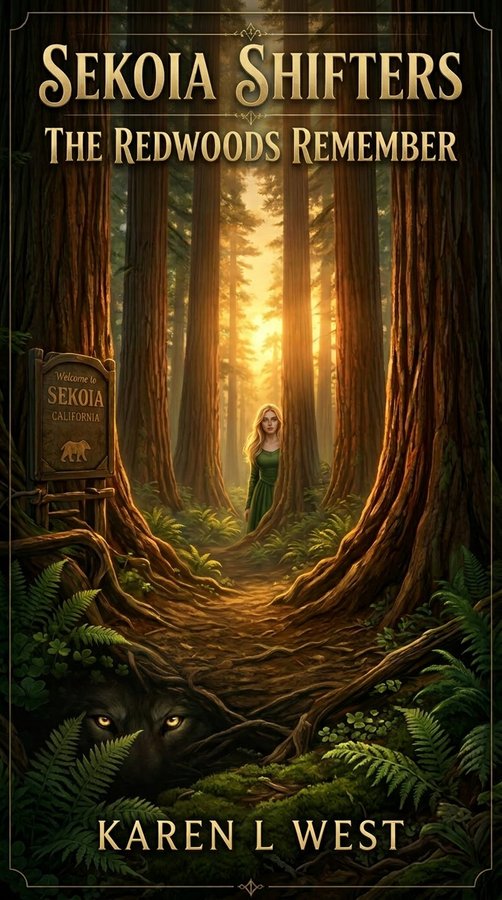
The judge's reasoning
A world earns belief one detail at a time — and Karen L. West earns it steadily, patiently, in the grain of the wood.
The Redwoods Remember builds Sekoia not through exposition dumps but through accumulation: bitter coffee on a burnt burner, Mrs. Voss's knitting needle caught mid-row, nine porch lights burning at three in the afternoon. The town becomes a living organism before the plot demands it. When West writes that "Sekoia always looked half-swallowed by the forest" and then lets the porch lights become "small yellow eyes watching the road," she's doing something genuinely skilled — the atmosphere is the argument. The redwoods are not backdrop. They are an entity, and the hollow where Elara hides has its own slow consciousness: "Not Council magic, not the clean-edged spell work she had felt around official seals and wards. This was older. Wilder. It did not lie on the bark. It had grown through it." That distinction — institutional magic vs. root-deep magic — is the kind of worldbuilding specificity that separates a setting from a stage.
The characterization matches it. Cree's patience with Solomon's lie — "When I know which answer will help him" — tells us everything about her in a single exchange. Ian's fear sharpening "thin" rather than loud is the work of a writer who understands restraint. And the light that "breathed" rather than burned is Elara's presence before she speaks a word. Readers who love found-family urban fantasy and nature-as-character will recognize this as their book immediately.

Judged by Dr. Aiyana Reyes — Science Fiction · Fantasy · Horror · Speculative
"A world earns belief one detail at a time."
Supporting passages
"Not Council magic, not the clean-edged spell work she had felt around official seals and wards. This was older. Wilder. It did not lie on the bark. It had grown through it."
West distinguishes two entirely different magic systems in three sentences — institutional vs. organic — giving the world immediate depth and internal logic.
"She could step over it. She knew that. She could force her way through the fog, follow Solomon's voice, drag the truth out into the open because she was his mother now. Because fear made people think force was the same as protection. Her boot lifted. The hum dropped lower. Cree set her foot back where it had been."
This moment crystallizes Cree's character — she understands the difference between protection and control, and acts on that understanding even when it costs her.
"He had stood there as if expecting the world to take one more thing from him and wanting to get the waiting over with. Ian had stepped aside. Cree had said, 'Come in.' That was all. Sometimes a life changed because someone opened a door."
The flashback earns its emotional weight through compression — no over-explanation, just the economy of the moment and the door.
Per-axis rubric scores
Every Booky-winning book is scored across all ten craft axes. The award category comes from the top axis; a second axis at or above 75 appears as secondary recognition.
Find out what your book does best.
Submit your book today. Get a real, honest, category-specific Booky — or every dollar back.
Submit Your Book → Screen Another Book