
Sekoia Shifter
by Karen L West
MOST VIVID PLACE BOOKY
Takes you to this book's Amazon page.
The judge's reasoning
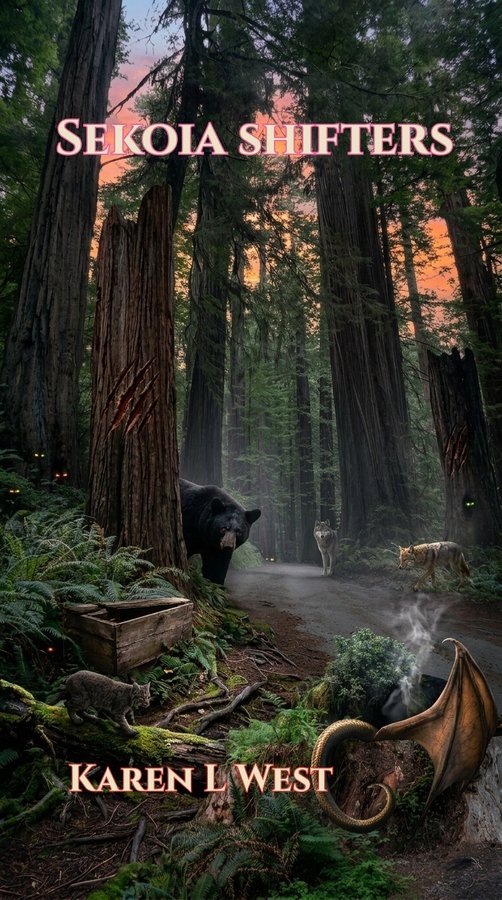
Karen L. West's Sekoia Shifter earns its strongest marks for the lived, textured world it builds around a small Northern California shifter community. The redwood forest is not backdrop — it is a character with its own logic, rhythm, and demands. West renders Sekoia through the senses with real specificity: "cold cedar and damp dirt," "burning coffee on a hot plate too long," a water bottle with a cartoon sticker wedged against a stump, a raven pecking once at a food locker before lifting off toward the river. These details accumulate into a place that feels genuinely inhabited rather than sketched. The town geography — the two long bends that keep Sekoia "broken into sections, each one tucked behind the next like a hand hiding something in its palm" — gives the setting spatial and tonal coherence that rewards the reader's investment.
The Characterization axis earns its score through protagonist Cree Wilson, a former Navy Senior Chief whose wolf-self, Sasha, operates as a distinct interior presence rather than a superpower she switches on. The dynamic between Cree's military-trained observation habits and Sasha's instinctual overlay — scent sharpening around a child's hoodie, the bone-level warning before the bear — is handled with restraint and feels genuinely integrated rather than expository. Cody, too, is sketched efficiently: the half-shown dragon rumble used to move a yearling bear is more characterization than pages of backstory. West trusts her readers to read the gap.

Judged by Eleanor "Nell" Whitcombe — Literary Fiction · Prose & Style
"A sentence either earns its breath or it doesn’t."
Supporting passages
"The road into Sekoia didn't come at you straight. It had two long bends that kept the town broken into sections, each one tucked behind the next like a hand hiding something in its palm."
This single image gives Sekoia spatial character and quiet menace simultaneously — the town's physical layout becomes a metaphor for what it conceals, doing double work with economy.
"I lifted the hoodie close to my face and pretended to inspect it. I took a breath through my nose. Cotton. Detergent. A child's sweat that had not turned sour yet. A faint smoky note from a campfire. I closed my eyes for a second, not for drama, but to block the visual noise and let the scent settle into something I could hold."
The parenthetical 'not for drama' is exactly the kind of self-aware, economy-of-motion characterization that makes Cree feel like a real professional rather than a genre archetype.
Per-axis rubric scores
Every Booky-winning book is scored across all ten craft axes. The award category comes from the top axis; a second axis at or above 75 appears as secondary recognition.
Find out what your book does best.
Submit your book today. Get a real, honest, category-specific Booky — or every dollar back.
Submit Your Book → Screen Another Book