
Run Way
by Patrick Ullmer
MOST INTERNALLY CONSISTENT CHARACTER BOOKY
Takes you to this book's Amazon page.
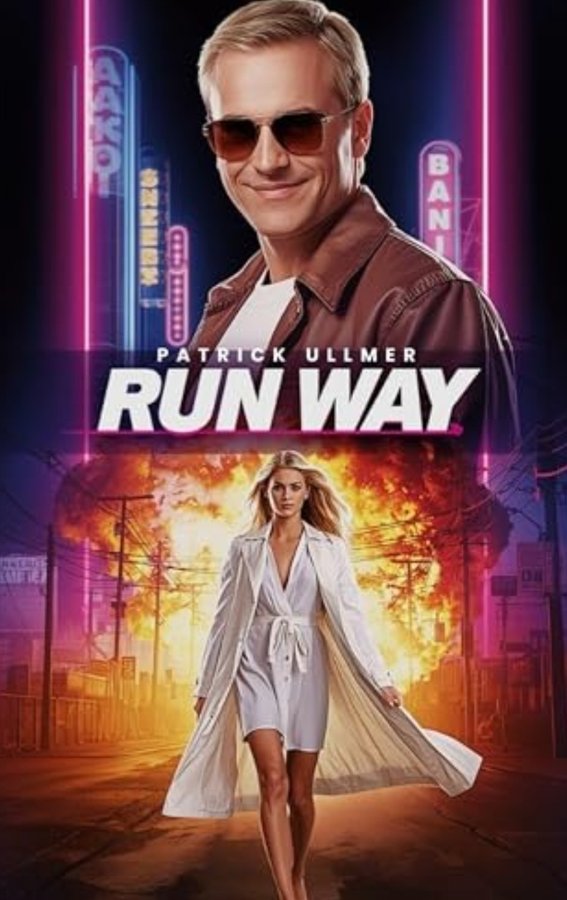
The judge's reasoning
Ullmer's real strength is Mitch Corvin — a character built out of specific, repeatable tics rather than adjectives. He lights matches with his teeth, extinguishes cigarettes on his own fingertip without flinching, and answers a job interview question about assault charges with 'I'd bring a gun' — nonchalant, unapologetic, and consistent across scenes. The bit where he distinguishes 'I apologize' (code for 'that's on you') from 'I'm sorry' (code for 'that's on me') is a small, well-observed piece of characterization that tells you exactly who this man is without narration doing the work for him. Juliette is drawn with equal care — not just a victim-in-waiting but a woman performing exhaustion for cameras while starving herself on coffee and half an apple, delivering the quietly devastating line about being told she has 'dead eyes.' The choice to replay their park meeting from her POV in Chapter 3, echoing 'Beautiful eyes... not as a compliment, but an observation' almost verbatim, is a clever structural move — it shows the same moment landing differently on each side of the exchange, which is harder to pull off than it looks.
The dialogue carries this characterization. 'Salad is what food eats' and 'No doy' aren't just quips — they're voice markers that stay consistent scene to scene, and the Ritchie confrontation ('Grab my boss again, and you'll be swallowing your own teeth') earns its punch because Mitch has been established as someone who talks first and hits precisely once talk fails. This is pulp built on real character chemistry, and that chemistry is the engine that will carry readers into the kidnapping plot the prologue promises.

Judged by Marcus Thorne — Thriller · Mystery · Suspense · Commercial Fiction
"Plot is promises kept."
Supporting passages
"'I apologize’ is code for ‘It's too bad your feelings got hurt because of what I said or did, but that's on you.’ ‘I'm sorry,’ is code for ‘I regret that I hurt you, and that's on me.’"
A small, specific piece of moral logic that defines Mitch more precisely than any physical description could.
"“What, you don't like food?” Juliette asked. “Salad is what food eats,” Mitch replied with a wry smile."
A tight, quotable exchange that establishes Mitch's deadpan voice and the class/appetite gap between the two leads in one line.
"Tonight, the hottest face of Innocence was going to be taken away, whether she wanted it or not."
The prologue's dramatic-irony hook keeps every subsequent 'one month earlier' scene charged with dread.
Per-axis rubric scores
Every Booky-winning book is scored across all ten craft axes. The award category comes from the top axis; a second axis at or above 75 appears as secondary recognition.
Find out what your book does best.
Submit your book today. Get a real, honest, category-specific Booky — or every dollar back.
Submit Your Book → Screen Another Book