
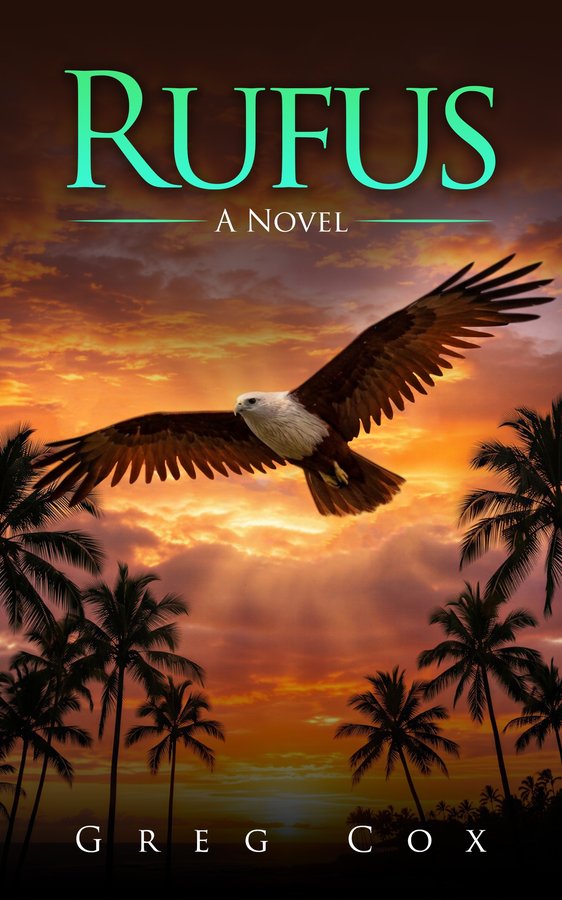
Rufus
by Gregory James Cox Cox
BEST SUBCULTURE PORTRAIT BOOKY
The judge's reasoning
Cox's real gift here is atmospheric specificity — the felt texture of North Queensland country, rendered without tourist gloss. The Townsville flat with its "balcony just big enough for two chairs and a crate for a table," the forest that "didn't welcome you... it just didn't care," the water dragon on Roaring Meg who speaks not in words but in "understanding" — these accumulate into a landscape that feels lived-in rather than researched. The rainforest survival sequence (shelter-building, snaring pigs, the python curling against Frank's thigh for warmth) has the unshowy authority of someone who knows what damp matches and blackened stem rot actually look like.
The prose leans plain and declarative — short sentences, minimal ornament — but it earns its keep in moments like the crack-in-glass opening image, or the devastating tonal pivot at Rossville, where sausages blackening on the grill become a fixed point of horror amid violence ("he remembered knowing which dog each one was by the sound of them not barking afterwards"). That restraint, letting the horror sit in domestic detail rather than spelling out grief, is the discipline this judge values most — Cox trusts the reader to feel Bluey and Pup's deaths without narrating anguish.
Peter's dialogue at China Camp — the buligi bambarr aside, the flat assessment "Your totem... that's rare, for a whitefella" — gives the book's mysticism ballast; it's delivered dry, unsentimental, which keeps it from tipping into cliché. Frank himself remains a little opaque as a character (more observed than interior), and the structure so far reads episodic rather than driven — but the sense of place, and the confidence to let a beat go unspoken, are genuinely earned.

Judged by Eleanor "Nell" Whitcombe — Literary Fiction · Prose & Style
"A sentence either earns its breath or it doesn’t."
Supporting passages
"The rainforest didn't welcome you. That was the first thing he noticed. It wasn't hostile, not exactly. It just didn't care."
Establishes the forest as an indifferent force rather than a backdrop, grounding the survival narrative in something true rather than picturesque.
"It wasn't some clean break, no slammed doors or last words worth remembering. It had been coming on for a long time, like a crack in glass you only notice once it's already run the length of it."
The extended crack-in-glass image is exactly the kind of earned, unforced metaphor that opens a book on the right footing.
""Buligi bambarr," Peter said. "Guugu Yalandji," Peter said. "That's what we call them... Same word we use for the coppers.""
Dry, specific, culturally grounded dialogue that does double duty as character texture and quiet humor without over-explaining itself.
Per-axis rubric scores
Every Booky-winning book is scored across all ten craft axes. The award category comes from the top axis; a second axis at or above 75 appears as secondary recognition.
Find out what your book does best.
Submit your book today. Get a real, honest, category-specific Booky — or every dollar back.
Submit Your Book → Screen Another Book