
BookyAwards · 2026
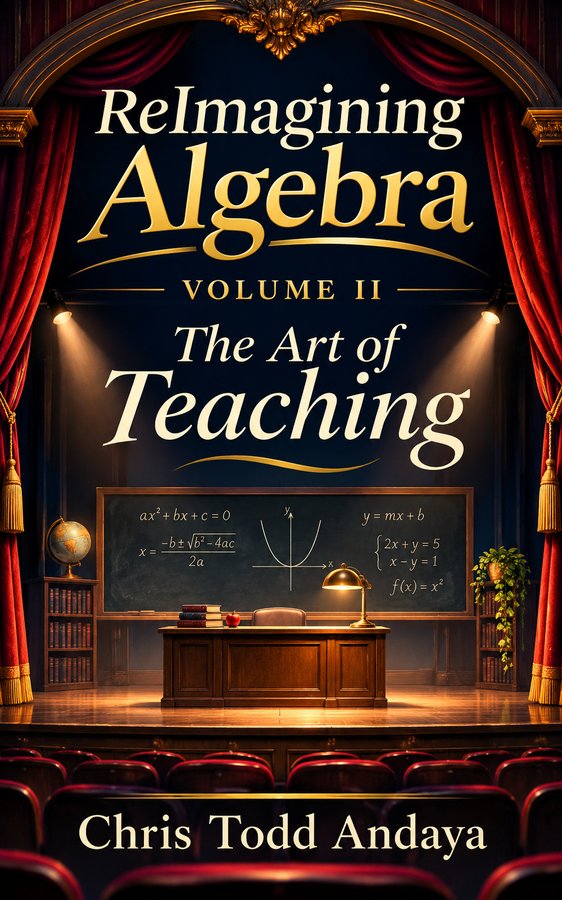
ReImagining Algebra volume 2 The Art of Teaching
by Chris Todd Andaya
Boldest Big Idea Booky
Retailer link provided by the author.
The citation
The judge's reasoning
This is a book with a real argument, and it builds it the hard way: not by asserting that teaching is hard, but by working the algebra in front of you. Andaya's opening thesis, that teaching is "a performance art, with the rigorous intent of imparting knowledge," is stress-tested for twenty-six chapters. Every time a technique appears, he pins down the claim it makes and the condition under which it holds.
Take the zero-product repair in Chapter 25. Students who solve (x − 2)(x + 5) = 0 by setting factors to zero will carry that cue straight into = 18 and answer two and negative five. Andaya does not tell the teacher to "reteach factoring." He locates the failed inference, builds a contrast pair, updates the notes, and designs a fresh check. Chapter 2's treatment of the equal sign, Chapter 19's lost solution in x(x − 2) = 0, and the (x² − 9)/(x − 3) domain discussion do the same work. The takeaway is usable on Monday.
The book is also honest about itself. The Note to the Reader says outright that the designs are "offered for examination" and are not measurements of effectiveness, and the endnotes decline to claim research support for his own campaigns and games. That restraint earns trust. The fundraising comparison in Chapter 21 and the event-planning model in Chapter 23 show a modeling task whose domain, threshold jump and rounding actually change the decision.
The weakness is texture. The voice is steady and dry but rarely personal, and the cumulative sameness of the "examine what the student can do next" move can blur chapters together.
From the book
Supporting passages
"The teacher's task is harder. We want students to acquire something they can carry out of the arrangement we built for them."
"The right-hand side is not decorative. It determines whether the property applies."
"Compression should record established meaning rather than conceal meaning that was never established."
The scorecard
Per-axis rubric scores
Every Booky-winning book is scored across all ten craft axes. The award category comes from the top axis; a second axis at or above 75 appears as secondary recognition.
- Prose & Style 79
- Characterization 70
- Dialogue 66
- Plot & Structure 84
- World-Building 82
- Originality 82
- Emotional Resonance 68
- Theme & Substance AWARDED 90
- Genre Execution SECONDARY RECOGNITION 89
- Marketability & Hook 76
Scores out of 100
Find out what your book does best.
Submit your book today. Get a real, honest, category-specific Booky — or every dollar back.
