BookyAwards · 2026
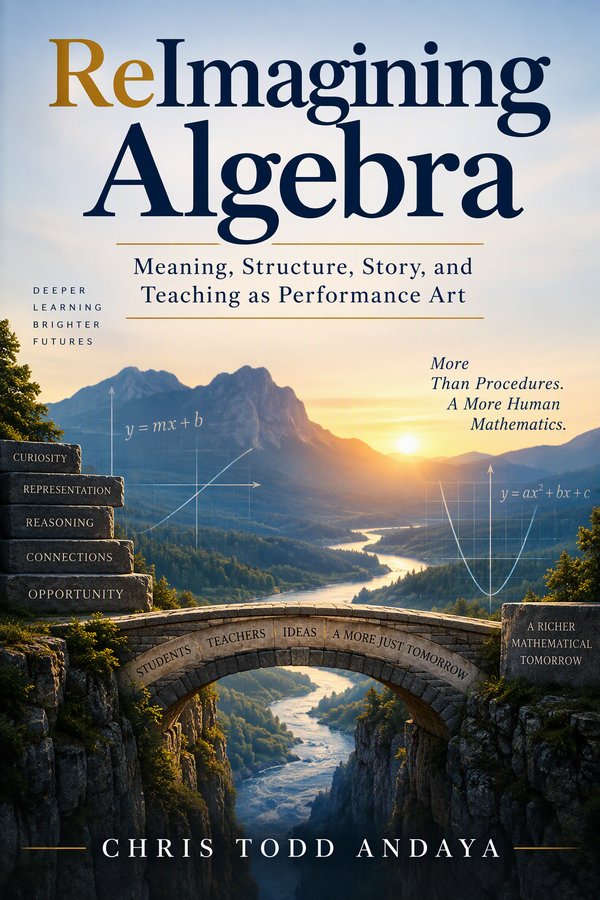
ReImagining Algebra volume 1 Foundations
by Chris Todd Andaya
Best Treatment of Hope Booky
Retailer link provided by the author.
The citation
The judge's reasoning
This is a book with an argument, and the argument is built to bear weight. Andaya's claim is that school algebra has been narrowed into a compliance system, and that the narrowing is structural, not the fault of lazy teachers or weak students. He then sets out five load-bearing ideas for what algebra actually is: relationship and dependency, equivalence and invariance, representation and translation, structure and form, and generalization. That structure is what earns the 'Theme & Substance' recognition.
The evidence is mostly argued and observed rather than data-driven, but it earns the claim. The student who 'could do everything except explain it' is the best scene in the book: a perfect page of linear work, then 'What does the three mean?' and the answer 'Go up three.' Andaya doesn't scold the student. He reads the answer as rational behavior in a system that rewards drawing the line over understanding the rate, then repairs it with a table and a change of step size. That is the book's thesis shrunk to one exchange, and it changes what a reader will do in Monday's class.
The scaffolding-and-cathedral allegory and the conveyor-belt-versus-trail-system image do real work. They give practitioners language they can carry into a department meeting. The chapter on how procedural algebra 'fits the system' (time, curriculum segmentation, scoring, accountability) is the sharpest analysis here. It explains why reform keeps reverting, which is the question most education books dodge.
The weakness is repetition. The central points recur across chapters in near-identical phrasing, and the prose leans on formulas ('not X, but Y'). A tighter edit and more concrete classroom evidence from the author's own game-based lessons would sharpen it. But as a foundational argument for teachers and instructional leaders, it delivers a real shift in how to look at an algebra classroom.
From the book
Supporting passages
"“What does the three mean?” The student looked down at the equation and answered immediately: “Go up three.” “Three what?”"
"A procedure can move cleanly from line to line while meaning remains stationary."
"Procedural algebra fits time. [...] Procedural algebra fits assessment. [...] Procedural algebra fits accountability structures."
The scorecard
Per-axis rubric scores
Every Booky-winning book is scored across all ten craft axes. The award category comes from the top axis; a second axis at or above 75 appears as secondary recognition.
- Prose & Style 79
- Characterization 70
- Dialogue 66
- Plot & Structure 83
- World-Building 77
- Originality 80
- Emotional Resonance 76
- Theme & Substance AWARDED 88
- Genre Execution SECONDARY RECOGNITION 85
- Marketability & Hook 79
Scores out of 100
Find out what your book does best.
Submit your book today. Get a real, honest, category-specific Booky — or every dollar back.
