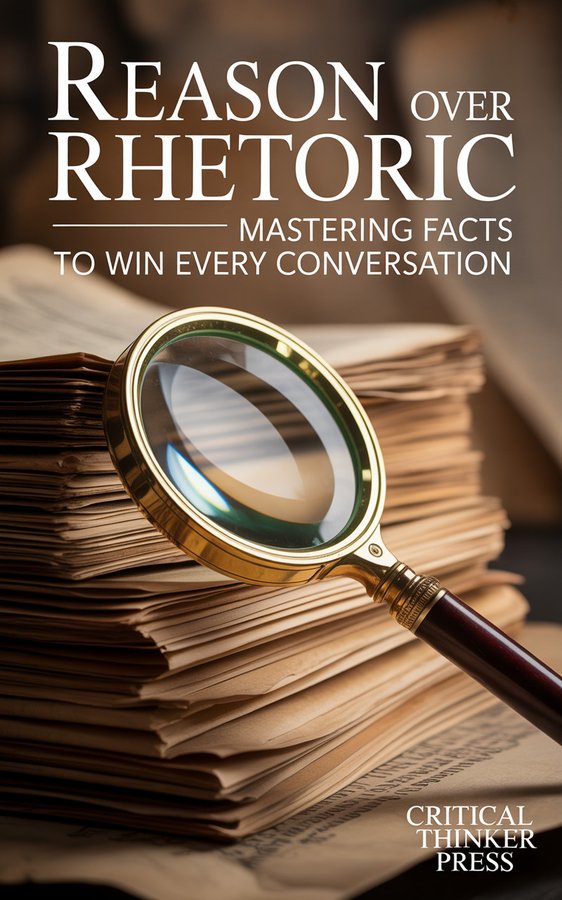
Reason Over Rhetoric
by Critical Thinker Press
BEST TREATMENT OF POWER BOOKY
Takes you to this book's Amazon page.
The judge's reasoning
Reason Over Rhetoric does what the best practical self-help books are supposed to do: it maintains a coherent, prosecutable argument from the first page to the last chapter visible here, and it delivers that argument with enough granularity that a reader can actually do something with it by the time they set the book down.
The thesis is not merely gestured at — it is worked. Each chapter is a logical extension of the last: the book establishes the stakes of reason vs. rhetoric in the introduction, maps the psychological terrain (cognitive biases, heuristics) in Chapter 2, then builds outward to evidentiary standards, emotional appeals, and fallacies. That progression is structural integrity, not decoration.
What earns this book its score on Theme & Substance is the care taken with definitions that are often blurred in the genre. The treatment of the data-vs.-opinion distinction in Chapter 3 — including the warning that "data itself isn't monolithic and invulnerable to bias" — resists the easy shortcut. The author acknowledges that even numbers can mislead depending on collection method and framing. That's the kind of earned nuance that separates honest pedagogy from boosterism.
The chapter on rhetorical techniques is similarly workmanlike: the taxonomy is standard (appeal to authority, bandwagon, false dilemma, loaded language) but the explanations are clean and the book correctly frames these not as tricks to defeat but as patterns to recognize — a meaningfully different posture that keeps the reader empowered rather than combative.
The prose is clear, occasionally flat, but rarely vague. It's a fair trade for a book whose core promise is epistemic clarity.

Judged by Arthur Beaumont — Non-Fiction · Memoir · Business · Self-Help
"A good non-fiction book changes one specific thing about your week."
Supporting passages
"It's also important to appreciate that data isn't monolithic and invulnerable to bias. The way data is collected, measured, and analyzed involves choices made by humans—choices that introduce potential errors or slants. Recognizing data involves examining the methodology or source, asking: Was the sample size adequate? Who collected this information, and why? What questions were asked?"
This passage demonstrates the book's willingness to complicate its own framework — a hallmark of intellectually honest non-fiction that earns the reader's trust rather than simply validating their priors.
"Questions like 'What evidence supports this?' or 'Are there alternative explanations?' act as a spotlight, focusing your mind on the critical aspects that shape the argument's validity. It sounds simple, but mastering the art of strategic questioning transforms conversations and debates alike, turning vague statements into fertile ground for rational exploration."
The book's self-help contract — teach a transferable habit — is fulfilled here with specific, usable language the reader can deploy in the next argument they encounter.
Per-axis rubric scores
Every Booky-winning book is scored across all ten craft axes. The award category comes from the top axis; a second axis at or above 75 appears as secondary recognition.
Find out what your book does best.
Submit your book today. Get a real, honest, category-specific Booky — or every dollar back.
Submit Your Book → Screen Another Book