
Potential: Unlocking The Power Of Who You Were Meant To Be
by Dr. Julius Vernon Poitier
MOST IMPORTANT CONVERSATION BOOKY
Retailer link provided by the author.
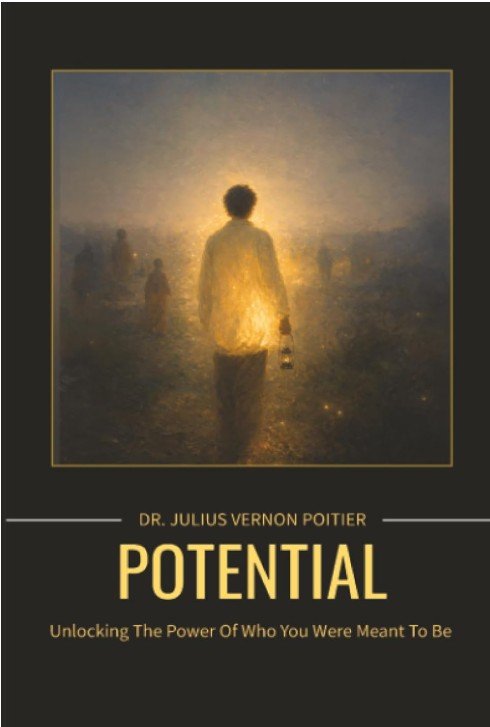
The judge's reasoning
Poitier's project is unusually ambitious for the genre: rather than open with a program of habits or a listicle of virtues, he interrogates a single word — potential — through etymology, psychology, philosophy, theology, and humanism, then braids those lenses into a personal reckoning. The chapter on potentia and potens ("Not achieving. Not succeeding. Not proving. Not meeting expectations. Simply being able.") is the book's real engine, and it earns its keep by returning to that distinction again and again rather than dropping it after the introduction.
Where the book delivers substance readers can use is in reframing 'unfulfilled potential' as a psychological trap rather than a moral failure — the line "There is no wasting... There is choosing, learning, adapting and becoming" gives a reader permission to stop auditing their own life against an imagined self. That's a usable emotional tool, not just a vibe.
The prose has genuine control in places — the tombstone-dash metaphor in Chapter 2 is well-built and sustained rather than a throwaway image, and lines like "Arrival is tidy. Becoming is alive" show a writer who edits for rhythm. The book's chief weakness so far is density without enough grounding scene: we're told Poitier feared the word for years, but we don't yet see the East Oakland kid on the page the way the dedication promises. If Part V delivers those specifics, the abstraction here will have earned its payoff. As it stands, this opening is a genuinely strong thesis chapter for a self-help book — thoughtful, well-sourced, and quotable — even if it asks patience before the personal narrative arrives.

Judged by Arthur Beaumont — Non-Fiction · Memoir · Business · Self-Help
"A good non-fiction book changes one specific thing about your week."
Supporting passages
"It was not asking me to accomplish. It was not demanding proof. It was inviting me to understand what it means to be unfinished."
The book's central reframe — potential as permission rather than obligation — stated with clarity.
"Like a bowstring drawn and waiting. Like a field before it rains. Like a seed swollen with the memory of the tree it does not yet know how to become."
Controlled, escalating imagery that shows real attention to sentence rhythm.
"There is a particular sorrow in discovering late that the prison was not locked."
A compact, aphoristic line that lands the emotional cost of the book's argument.
Per-axis rubric scores
Every Booky-winning book is scored across all ten craft axes. The award category comes from the top axis; a second axis at or above 75 appears as secondary recognition.
Find out what your book does best.
Submit your book today. Get a real, honest, category-specific Booky — or every dollar back.
Submit Your Book → Screen Another Book