
BookyAwards · 2026
Post-Fire Scene Safety and Health: Practices and Strategies
by Jeffrey L Pauley
Best Treatment of Mortality Booky
Retailer link provided by the author.
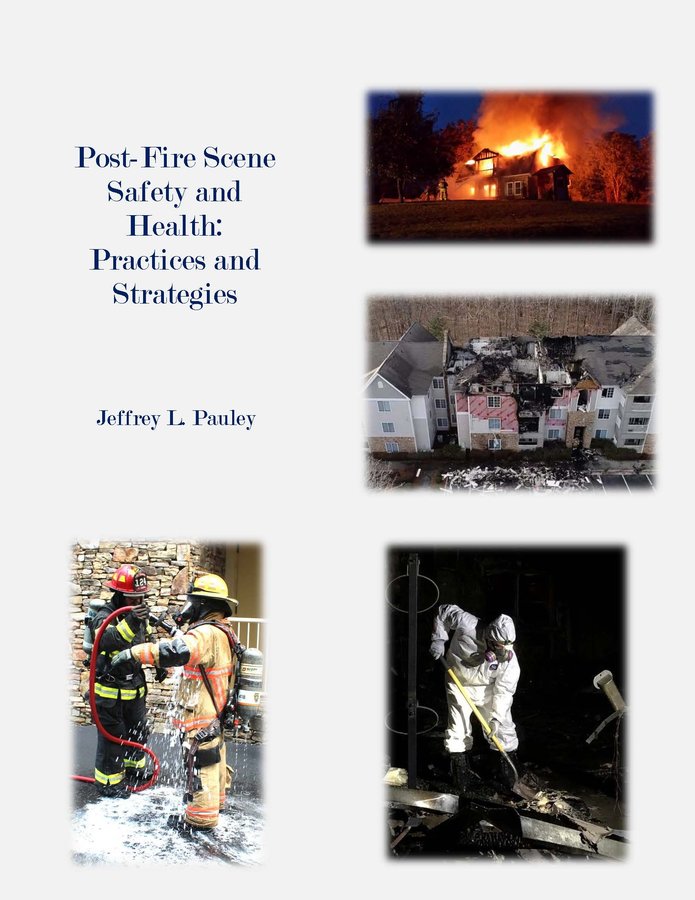
The citation
The judge's reasoning
A good non-fiction book changes one specific thing about your week. This one changes what a fire investigator puts on their face before walking into a "cold" scene, and that matters because the mistake it corrects is quietly lethal.
Pauley's argument is real, not a cluster of vibes. The post-fire scene is a hazard environment that the profession has treated as safe because nothing is visibly burning. He builds the case with evidence that earns the claim. The UL FSRI test fires showed formaldehyde climbing over time, often past the NIOSH ceiling limit. The University of Miami wristband study found naphthalene and phenanthrene on investigators' wrists. The ATF bladder-cancer study and the 3M particle hang-time data are put to work, not just cited. The author's own arithmetic finishes the point: a firefighter spends 1 to 5 percent of work time in the fire environment, and an investigator needs only 12 to 58 scenes a year to match that exposure. His coinage "Blue Sky Syndrome" names the misconception so readers can recognise it in themselves.
The practicality is the strength. The book supplies the specific P100/OV/AG/FM cartridge assembly (magenta filter, olive cartridge) and the field-decon sequence with its hint to bag items in clear plastic "so they don't get mistakenly thrown away. It has happened!" The BE CAREFUL briefing mnemonic, a model SOP outline, a briefing checklist and a rehab-station bench criteria all go straight to work. The Syracuse chimney fatality, run through the five-pillar root-cause chain, shows the whole systems argument in one case.
The prose is plain, and the book reads as a manual with a conscience. The dedication to investigators who "may be paying for it now" gives it a moral center, and the author is willing to say what he thinks.
From the book
Supporting passages
"One of the biggest misconceptions, if not the biggest, about the post-fire scene is that a cold scene is a safe scene and therefore does not require any personal protective equipment (PPE), including respiratory protection. This could not be further from the truth."
"HINT: Place items to be cleaned in clear plastic bags so they don't get mistakenly thrown away. It has happened!"
"In the bigger scheme of things, I don't know that many fire investigators. Sure, I know a bunch, but compared to the 7 to 10 thousand that are employed in the US today, I don't know that many. And yet, at least 4 to 6 times a year, I get a call or a text that a current or former fire investigator has been diagnosed with occupational cancer."
The scorecard
Per-axis rubric scores
Every Booky-winning book is scored across all ten craft axes. The award category comes from the top axis; a second axis at or above 75 appears as secondary recognition.
- Prose & Style 72
- Characterization 70
- Dialogue 68
- Plot & Structure 80
- World-Building 82
- Originality 82
- Emotional Resonance 76
- Theme & Substance AWARDED 90
- Genre Execution SECONDARY RECOGNITION 86
- Marketability & Hook 79
Scores out of 100
Find out what your book does best.
Submit your book today. Get a real, honest, category-specific Booky — or every dollar back.
