
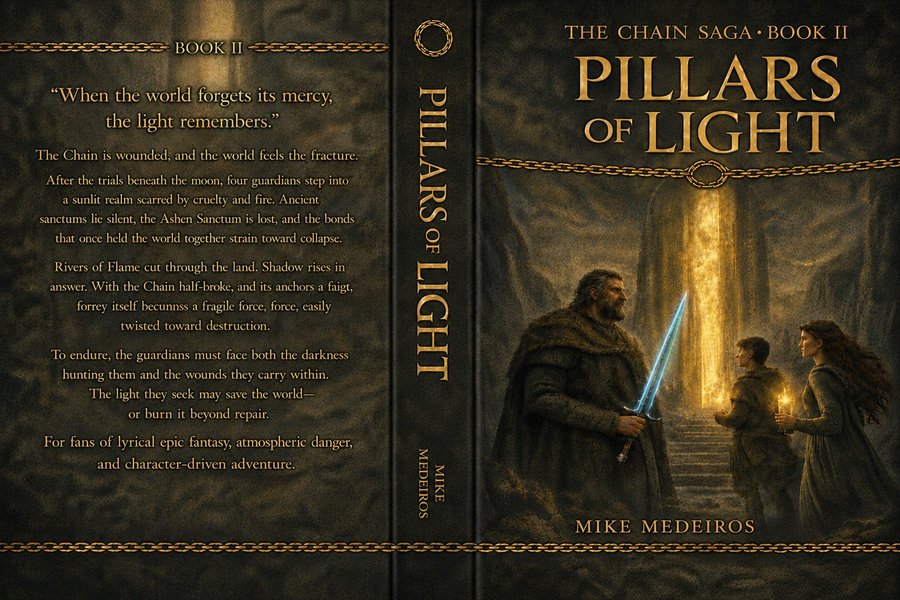
Pillars of Light
by Mike Medeiros
MOST UNSETTLING ATMOSPHERE BOOKY
Takes you to this book's Amazon page.
The judge's reasoning
The strongest thing in Pillars of Light isn't the fellowship's march or the dialogue exchanged around campfires — it's the Chain itself, a magic system built not on spells but on epistemology. Medeiros imagines a binding force sustained by vow and memory, and then asks the genuinely interesting question: what happens when something learns to mimic memory without holding its truth? The river-figure that rises from the Tellenfirth ford and says "Remember me" — hollow-eyed, borrowing the Chain's own cadence — is a lovely piece of world logic made flesh: a corruption that isn't monstrous so much as derivative, an echo mistaking itself for a source. That idea pays off again at Frostmarch, where the council has literally caged a fragment of the Chain in a glass column to power their forges, and Rale's diagnosis — "They starve its purpose to feed their pride" — turns architecture into theme. The corridors of blue crystal-light, described as "trained... chained within its own reflection,” extend the same metaphor into set design, so the citadel itself argues the book's thesis before anyone speaks a line of dialogue. That's a rare discipline in a debut-feeling epic: the setting is doing philosophical work, not just scenery. The prose leans purple and the cast speaks in near-identical oracular register, but the underlying architecture of belief, imitation, and the labor of remembering rightly is coherent and sustained across every scene shown here. Readers who want a magic system with genuine stakes attached to truth-telling will find real substance underneath the mist.

Judged by Dr. Aiyana Reyes — Science Fiction · Fantasy · Horror · Speculative
"A world earns belief one detail at a time."
Supporting passages
"The Chain’s current moves through all things, but here it rested. The first bearers created places where light could pause and remember itself. These are the resting veins of memory."
A concrete, load-bearing piece of magic-system lore delivered through character voice rather than exposition dump.
"Order without understanding becomes obedience. The Chain was not made to rule; it was made to remind."
Crystallizes the book's central argument about memory, authority, and complacency in a single aphorism the plot actively tests.
Per-axis rubric scores
Every Booky-winning book is scored across all ten craft axes. The award category comes from the top axis; a second axis at or above 75 appears as secondary recognition.
Find out what your book does best.
Submit your book today. Get a real, honest, category-specific Booky — or every dollar back.
Submit Your Book → Screen Another Book