
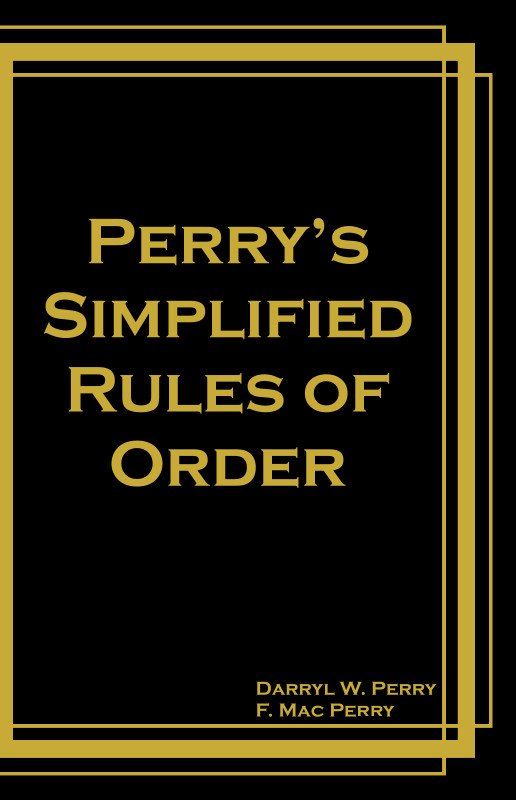
Perry’s Simplified Rules of Order
by Darryl W Perry
BEST BUSINESS BOOK BOOKY
Takes you to this book's Amazon page.
The judge's reasoning
Perry's Simplified Rules of Order does exactly what it sets out to do, and it does it with disciplined clarity. That is no small achievement in a field dominated by Robert's Rules of Order — a document many organizations adopt precisely because they cannot understand it, and then weaponize for the same reason.
The book's philosophical premise is stated in four lines of the Introduction and never abandoned: rules of order are not meant to be wielded by a learned class against laypeople. Every structural decision that follows enforces this conviction. The Vocabulary chapter (Section 0) is particularly deft — by establishing upfront that the Chair must interpret a member's intent rather than penalize imprecise terminology, the authors have embedded an anti-obstruction ethic into the architecture of the rules themselves, not merely into a preamble.
The fictional meeting scenario earns its place. What could have been a dry dramatization becomes a genuinely useful teaching document — the challenge to the Chair's ruling over the 2/3 vs. majority question (Sections 7.2 and 3.9) is a live demonstration of ambiguity resolved in real time, with the Chair citing the rule number on the floor. That specificity is trust-building. The cheat-sheet tables at the close are well-designed: the footnotes handle exceptions without cluttering the main grid, and the Order of Precedence chart answers the question every new parliamentarian actually has first.
For any small organization, committee, or deliberative body that needs workable rules without a parliamentarian on retainer, this book delivers practical authority in under forty pages. That economy is itself a form of craft.

Judged by Eleanor "Nell" Whitcombe — Literary Fiction · Prose & Style
"A sentence either earns its breath or it doesn’t."
Supporting passages
"Rules of Order are not meant to be used as a weapon by a learned class against the layperson."
This single sentence from the Introduction names the exact failure mode the book is designed to prevent, and every procedural choice that follows is legible as a response to it.
"0.1. Whenever a member makes a motion, call, challenge, or point of order the Chair shall not deem it to be out of order simply because the member used the wrong term."
The authors convert their philosophical premise — accessible participation over procedural gatekeeping — into a concrete, enforceable rule at the very first numbered section, demonstrating that the book's values and its mechanics are unified.
"M4: You stated that this motion was not a suspension of the rules and only requires a majority to pass. M2 stated "Motion to suspend the rules to elect the person who gets the most votes." That requires a 2/3 vote. C: Our rules are clear that a suspension of the rules requires 2/3 vote in order to hear a motion. The motion then only requires a majority to pass. See 0.2.3 and 3.9 of PRO."
The scenario earns its length here: a genuine interpretive dispute is modeled in real time, and the Chair's citation of specific rule numbers shows readers exactly how to use the reference text in practice.
Per-axis rubric scores
Every Booky-winning book is scored across all ten craft axes. The award category comes from the top axis; a second axis at or above 75 appears as secondary recognition.
Find out what your book does best.
Submit your book today. Get a real, honest, category-specific Booky — or every dollar back.
Submit Your Book → Screen Another Book