
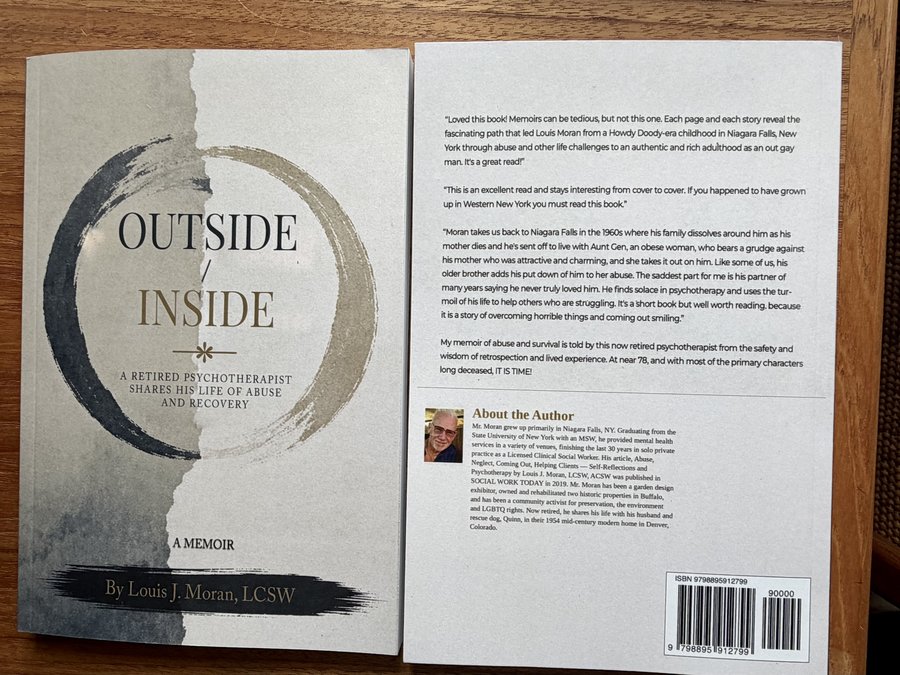
Outside//Inside
by Louis J. Moran, LCSW
MOST HUMANE STORY BOOKY
Takes you to this book's Amazon page.
The judge's reasoning
Moran's forty-four years as a clinical social worker earn their place on the page. This isn't just an inventory of abuse — it's abuse examined by someone trained to ask why it happened and what it did to him, and he doesn't let himself off the hook either: "reflection can teach us what it was within ourselves that contributed to keeping us in the victim position. To that degree we can be complicit in the harm that was done to us." That's a real argument, not just a confession, and it earns the book's clinical framing (hypervigilance vs. presence, the psychology of a favored vs. sacrificial sibling) without the prose curdling into a textbook.
The emotional core lands hardest in the small, undramatized moments: the six-year-old standing in the corner of the room while his father and brother collapse on the bed together, nobody pulling him in — "I still cry when I think about this memory. Some tears are just endless." That restraint, paired with the narrator's own admission that he still doesn't fully understand why no one reached for him, is more affecting than a more polished memoir's set-piece grief would be.
Aunt Gen is the book's best-drawn villain-with-humanity — "Poor Louis my ass! If it wasn't for me the little bastard would be out on the street" tells you everything about the transactional, threat-laced household in four lines. The liver-down-the-table-legs bit, the Priceline stock humiliation, Samson the monkey biting women — these details do the work generic trauma-memoir prose usually can't. The dual narration (Franny's voice, then "Boo Speaks!!") is a clever structural choice for depicting how two siblings inherit the same house differently.

Judged by Arthur Beaumont — Non-Fiction · Memoir · Business · Self-Help
"A good non-fiction book changes one specific thing about your week."
Supporting passages
"I believe that, more importantly, reflection can teach us what it was within ourselves that contributed to keeping us in the victim position. To that degree we can be complicit in the harm that was done to us."
The clinical training pays off here — this is a book making an argument about complicity and survival, not just cataloguing wounds.
"Dad and Franny fell on the bed crying and holding each other. I was standing in the corner of the room by myself watching and not really understanding. I am not sure why I didn't just get on the bed with them. I am not sure why they didn't pull me on to the bed with them. I still cry when I think about this memory. Some tears are just endless."
The unresolved question — why wasn't he pulled in — carries more grief than any dramatized scene of mourning could.
"Aunt Gen bristled and shouted, “Poor Louis my ass! If it wasn’t for me the little bastard would be out on the street.”"
One line of dialogue that establishes the household's entire economy of obligation and threat.
Per-axis rubric scores
Every Booky-winning book is scored across all ten craft axes. The award category comes from the top axis; a second axis at or above 75 appears as secondary recognition.
Find out what your book does best.
Submit your book today. Get a real, honest, category-specific Booky — or every dollar back.
Submit Your Book → Screen Another Book