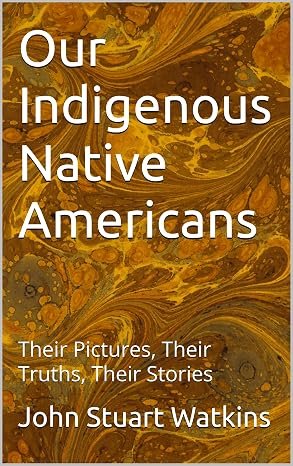
Our Indigenous Native Americans
by John Stuart Watkins
MOST AUTHENTIC MEMOIR BOOKY
Takes you to this book's Amazon page.
The judge's reasoning
Watkins is upfront about what this book is: 'a collection of pictures, maps, stories, and a poem or two, to help paint as accurate a picture as I can.' Judged as a scrapbook-history rather than a scholarly monograph, it delivers exactly that, and delivers it with real generosity of scope — Choctaw code talkers, Ute origin poetry, the Great Race legend across Suhtai, Lakota, and Cheyenne tellings, Joseph Medicine Crow's raid on fifty SS horses ('singing a traditional Crow honor song as he rode'), and Elizabeth Penney Wilson's work preserving nimipuutimt. Few single-author volumes stitch together this many tribes, regions, and centuries in one binding, and the author does the unglamorous work of naming sources — Wikipedia, the National Park Service, individual submitters like Henk Sparreboom and Aaron Shakespear — so a curious reader has a trailhead into further research.
Where the book earns its second axis is in the moments Watkins steps out from behind the clippings and speaks from his own life. The passage on his summer as a BLM firefighter working alongside Eskimo and Athabaskan crews — burying meat under tundra to keep the smell from bears — is the one stretch of true first-person world-building in the manuscript, and it's good enough that you wish there were ten more like it. The dedication, too, does real work: 'Perhaps we can acknowledge some wrongs, and even correct them?' is a modest, sincere frame for what follows, and the admission that 'my research has made me humble as I learn more about what I don't know' is the right note for a book built from other people's scholarship.
This is not an argument-driven history — the structure is associative rather than built, and the prose is mostly other people's prose, quoted and unedited. But as an act of assembly and stewardship — bringing lesser-known figures like Elizabeth Penney Wilson, Chief Flying Hawk, and the Choctaw Code Talkers into one place next to the famous names — it succeeds at what it set out to do.

Judged by Arthur Beaumont — Non-Fiction · Memoir · Business · Self-Help
"A good non-fiction book changes one specific thing about your week."
Supporting passages
"This is a collection of pictures, maps, stories, and a poem or two, to help paint as accurate a picture as I can. Some chiefs are included that never get attention, but they deserve to be included."
States the book's actual project — breadth and inclusion over argument — and the manuscript delivers on it.
"I attended the University of Alaska in Fairbanks and fell in love with the history, the people, the wilderness. One summer I was a BLM Emergency firefighter and worked with Eskimo crews, Athabaskan crews, and learned the differences."
The one passage of lived, first-hand testimony in the book, and it grounds the Alaska Native material in something more than a caption.
"He crept into the camp, released the herd, and led them away — singing a traditional Crow honor song as he rode."
A small, vivid image of Joseph Medicine Crow's raid that lands emotionally without editorializing.
Per-axis rubric scores
Every Booky-winning book is scored across all ten craft axes. The award category comes from the top axis; a second axis at or above 75 appears as secondary recognition.
Find out what your book does best.
Submit your book today. Get a real, honest, category-specific Booky — or every dollar back.
Submit Your Book → Screen Another Book