
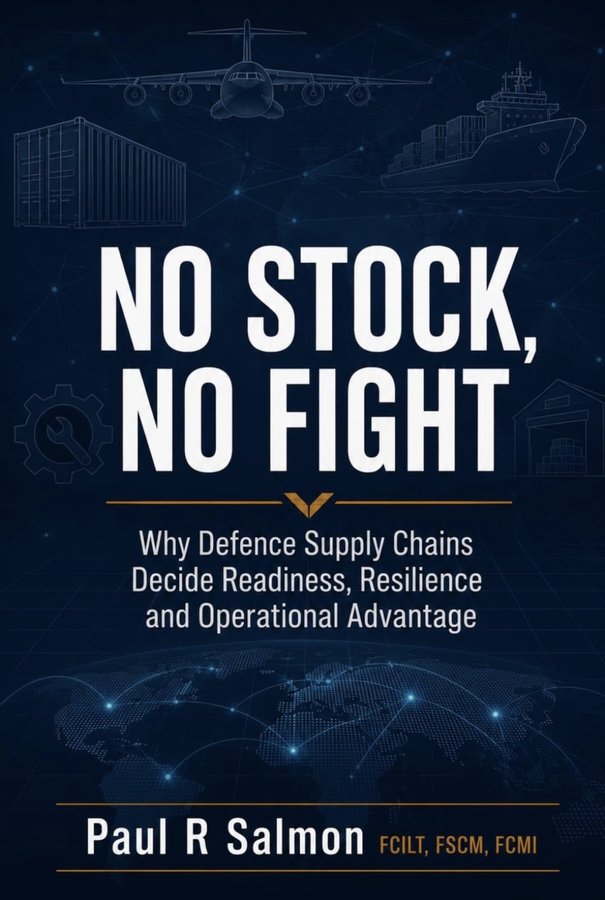
No Stock No Fight
by Paul Salmon
MOST QUIETLY PROFOUND BOOKY
The judge's reasoning
This is a book written by someone who has stood in the warehouse and the boardroom and knows the distance between them. Its central claim, that Defence capability is sustained by stock, repair, data, suppliers, decisions and people rather than by platforms alone, is simple, defensible and carried through thirty chapters with unusual consistency. The title phrase "No stock, no fight" is immediately qualified ("It does not mean that stock alone is enough"), which is exactly the intellectual honesty the subject needs.
The strongest chapters turn practitioner knowledge into usable reframing. Chapter 15 on Mean Time to Repair separates active repair time from waiting time and shows that "the physical repair may be only a small part of the total elapsed time." Chapter 18's "72-hour problem" names something every logistician recognises: "Not making a decision is itself a decision." Chapter 8 argues that "A one-pound item can stop a million-pound asset," and Chapter 17 makes the practical case for re-brigading existing stock before buying more. Each offers a specific diagnostic and not just exhortation, and the segmentation of items by criticality rather than value is a genuinely useful corrective to ABC thinking.
The book is generous to its reader: Appendix B's readiness checklist and Appendix A's reflection questions make it a working tool for its intended audience of Defence and supply chain professionals. The cost is repetition. Chapters re-announce the same themes, and the prose leans on triads and anaphora where a plain sentence would do. Even so, the author's voice and conviction come through, and this earns recognition for substance.

Judged by Eleanor "Nell" Whitcombe — Literary Fiction · Prose & Style
"A sentence either earns its breath or it doesn’t."
Supporting passages
"Not making a decision is itself a decision."
Distils the 72-hour problem into a single, memorable principle that reframes deferral as an active choice with operational consequences.
"A one-pound item can stop a million-pound asset."
Captures the book's core insight that operational consequence is not proportional to cost, in a line a senior leader can repeat.
"Visibility is not the same as control."
Opens the orchestration chapter by naming the exact gap between dashboards and action that practitioners in this field live with.
Per-axis rubric scores
Every Booky-winning book is scored across all ten craft axes. The award category comes from the top axis; a second axis at or above 75 appears as secondary recognition.
Find out what your book does best.
Submit your book today. Get a real, honest, category-specific Booky — or every dollar back.
Submit Your Book → Screen Another Book