
BookyAwards · 2026
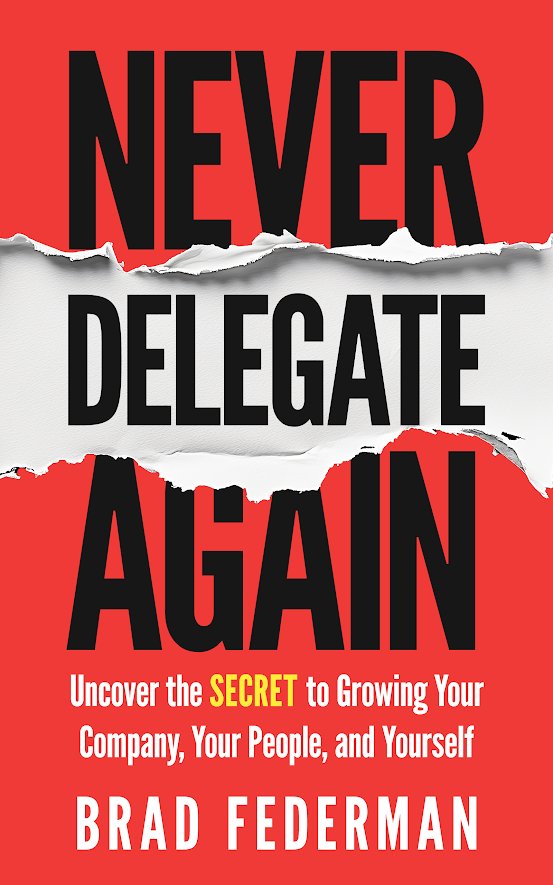
Never Delegate Again
by Brad Federman
Most Adaptable to Screen Booky
The citation
The judge's reasoning
Never Delegate Again earns its place on the strength of one inverted idea: stop treating delegation as task transfer and start treating every assignment as a deliberate growth opportunity. A title that tells a manager to do the opposite of what every leadership course says is a hook, and Federman backs it with a book that delivers.
The substance is practical, which is what this category rewards. The four-step process (define, match, share, support) gives a manager something to run on Monday. Chapter 6 insists you define the assignment before you think of a person, so the task picks the person and the usual suspects stop getting everything. The Growth Matrix, built against the Eisenhower Matrix, makes a sharp, specific point. A rule that says urgent-but-unimportant work gets delegated tells your team what you think of them. Jamila's "fantastic project" that turns out to be her boss's tedious admin is the book's argument in miniature. Tina's red-inked report, and the confession she drags out of herself ("I think I'd be pissed off"), shows a leader producing the behaviour she complains about. The unprepared employee who presents to a brutal executive committee, and the SVP's "I handed them a test they didn't even know they were taking," put a price on skipping the support step.
The argument keeps its shape. The FastForward change stages, the ambiguity and collaboration work-style factors, and the STIRS question sequence (spark, target, inspire, redress, support) all serve the same thesis. The explanation of why roadblock questions come late is a real coaching insight: raise obstacles first and you kill the idea. The reflection questions at each chapter's end are usable as written.
From the book
Supporting passages
"Most people think delegation is only about handing off tasks—redistributing the work to focus on more important things. But what they’re often really doing is dumping."
"Managers delegate. Leaders grow."
"I handed them a test they didn’t even know they were taking."
The scorecard
Per-axis rubric scores
Every Booky-winning book is scored across all ten craft axes. The award category comes from the top axis; a second axis at or above 75 appears as secondary recognition.
- Prose & Style 72
- Characterization 74
- Dialogue 76
- Plot & Structure 81
- World-Building 77
- Originality 79
- Emotional Resonance 75
- Theme & Substance SECONDARY RECOGNITION 84
- Genre Execution 83
- Marketability & Hook AWARDED 85
Scores out of 100
Find out what your book does best.
Submit your book today. Get a real, honest, category-specific Booky — or every dollar back.
