
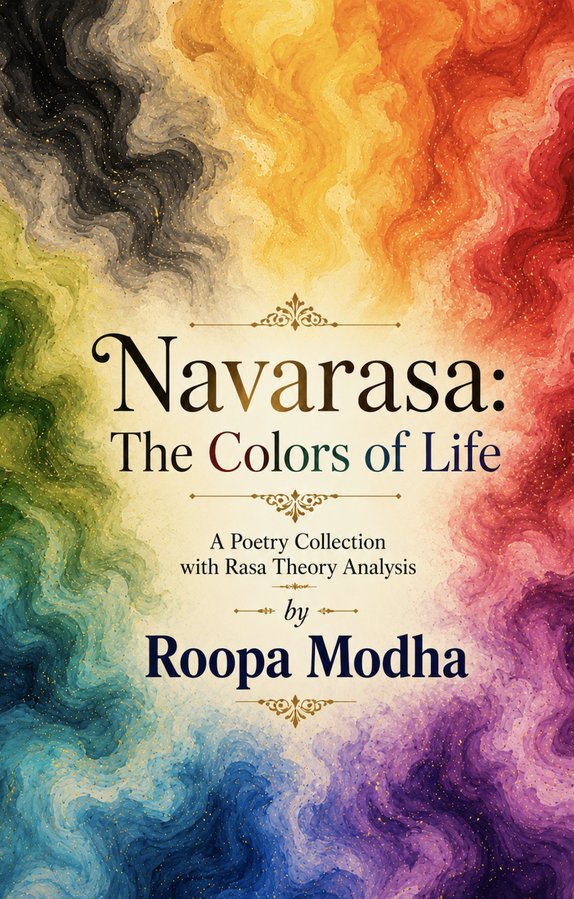
Navarasa The Colors of Life
by Roopa Modha
BEST TREATMENT OF EMOTION BOOKY
Takes you to this book's Amazon page.
The judge's reasoning
Navarasa: The Colors of Life earns its Booky squarely on the strength of its intellectual architecture — which is rarer than it sounds in contemporary poetry collections. Roopa Modha doesn't just write poems about emotion; she builds a framework around emotion, drawing on the ancient Indian aesthetic theory of Rasa (originating in the Natya Shastra) to map nine foundational human sentiments — shringara, raudra, karuna, shanta, and the rest — across a three-part emotional journey from Sunset through Sparks of Light to Horizons. That structural ambition is real and it pays off.
What makes this genuinely substantive rather than merely ambitious is how the back-matter analysis illuminates the poems without suffocating them. The decision to place all Rasa Theory analysis after each section — so poems breathe first — is a craft choice that respects the reader. Then the analysis delivers: the note on "Blame The Light" that shanta here represents "not peace, but the lingering silence when a relationship ends due to ego" is precisely the kind of distinction a thoughtful teacher makes. Similarly, the reading of "Copycat" as a poem whose staccato beat enacts the hollow mimicry it describes shows a poet thinking about form as argument.
The collection's originality lies in this cross-cultural, cross-genre hybrid — part poetry collection, part aesthetic philosophy primer, part self-help in the best sense. "Consumed," with its image of a man burning the bridge he was standing on, and "The Chat," whose AI punchline lands with gentle irony about modern loneliness, show Modha's tonal range. This is a book that knows exactly who it is for: a reader who wants emotional poetry and wants to understand why it moves them.

Judged by Brooke Hayes — Reader-at-Large · Cross-Genre · Emerging Voices
"Every book is the only book for somebody."
Supporting passages
"As the last leaf falls from the tree, / So do you fall from my heart, I see. / I believed you to be an eternal spring, / Taking you selflessly under my wing. / The bond was pure - at least I was true, / But seasons change, as did you."
The natural metaphor earns its weight here because the poem earns it — the seasonal logic tracks precisely with the emotional argument that growth and loss are the same cycle.
"Shanta (peace) rasa can be considered to be present in the final two lines of the stanza where the colors fade to white. I specifically did not fade to black, but to white to emphasize the void he has created in his own life."
This is Modha at her most original: the analytical note reveals an intentional color-theory decision that transforms a small poetic choice into a philosophical statement about self-erasure.
"The shadows of my past play in my mind… like embers from the fire… / Twisting. Playing. Crackling. / Mocking? / No. Not mocking. / Teaching."
The mid-poem correction — the pivot from 'Mocking?' to 'Teaching' — is the collection's most emotionally alive moment, a speaker actively revising her own trauma narrative in real time.
Per-axis rubric scores
Every Booky-winning book is scored across all ten craft axes. The award category comes from the top axis; a second axis at or above 75 appears as secondary recognition.
Find out what your book does best.
Submit your book today. Get a real, honest, category-specific Booky — or every dollar back.
Submit Your Book → Screen Another Book