
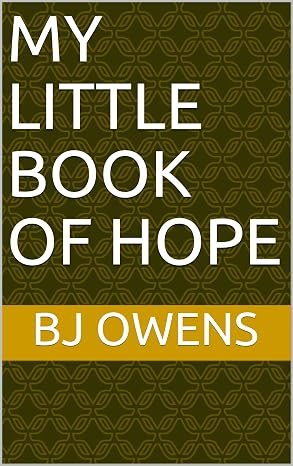
My Little Book of HOPE
by Beverly Jane Owens
BEST TREATMENT OF FORGIVENESS BOOKY
The judge's reasoning
Owens earns her strongest ground on substance, and it's a genuinely useful one: the distinction she draws between being a depressed person and being a person living with depression. That's not a slogan — she builds to it through the whole opening section, from the "shattered mass of broken mirrors" of her identity chapter to the reframe that closes it. It's a takeaway a reader can actually use tomorrow morning: separate the illness from the self, then manage the illness with knowledge and the right medication rather than willpower alone.
What keeps this from being generic self-help boilerplate is how specific the argument stays to her own case. She doesn't just cite serotonin and dopamine — she names Dr. Farabee, tracks five or six medication changes, and is blunt that Prozac worked for her when other tricyclics didn't, undercutting any one-size-fits-all pitch a lesser book would make. The joke about the light bulb ("But the light bulb had to want to change") lands because she's earned it with pages of resistance first.
The emotional material backs this up rather than just decorating it. The line about pointing "the nose of my car off the brink of a high ridge" is delivered flatly, almost administratively, which is more devastating than melodrama would be. Same with the family history she doesn't flinch from — an alcoholic mother, an institutionalized aunt and uncle, three cousins lost to suicide — stated as inventory, not spectacle. The prose is uneven and the poems are the weakest element, but the argument itself — that depression is a manageable chronic condition, not a moral failing, and that identity can be rebuilt around that fact — is coherent, earned, and exactly what this book's intended reader is looking for.

Judged by Arthur Beaumont — Non-Fiction · Memoir · Business · Self-Help
"A good non-fiction book changes one specific thing about your week."
Supporting passages
"I no longer see myself as a depressed person. I view myself as a person living with depression. There is a difference. What separates the two? Knowledge."
This is the book's operative thesis, stated plainly and then demonstrated across the manuscript rather than just asserted once.
"How much easier it would be to point the nose of my car off the brink of a high ridge and slip peacefully into that final sleep."
The flatness of the delivery, rather than dramatizing the thought, makes the suicidal ideation land harder.
"Almost every man in our area depended on that tile plant to feed and house his family. But each evening when I went outside to play, grainy black soot covered every tree, road, blade of grass, and dulled the beauty of the flowers."
A concrete, specific image of the Appalachian working-class world she's describing, grounding the memoir beyond abstraction.
Per-axis rubric scores
Every Booky-winning book is scored across all ten craft axes. The award category comes from the top axis; a second axis at or above 75 appears as secondary recognition.
Find out what your book does best.
Submit your book today. Get a real, honest, category-specific Booky — or every dollar back.
Submit Your Book → Screen Another Book