
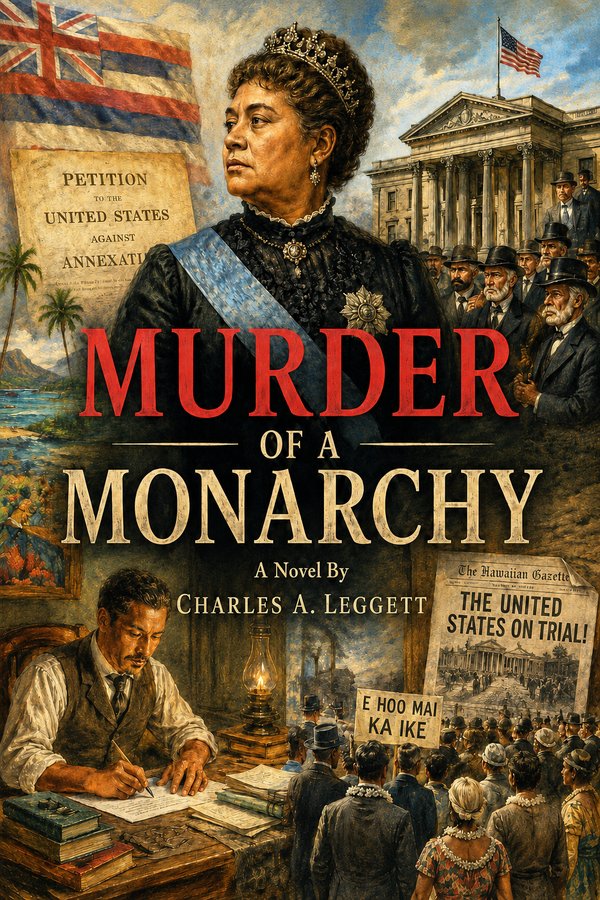
Murder of a Monarchy
by Charles A. Leggett
BEST TREATMENT OF REDEMPTION BOOKY
Retailer link provided by the author.
The judge's reasoning
Charles Leggett has taken a wound that most American readers were never taught to see and given it a human address: a three-room house in Mākaha, a kerosene lamp, a lawyer arguing over a pig. That choice is the book's quiet intelligence. Kale's first case, Keoki's "trespass" for hunting wild boar on land now fenced and surveyed, makes the overthrow legible at the scale where dispossession actually happens. "To the court, they described a pig. To Kale, they described a valley being taught to forget its own paths." The grand injury and the small one are tied together before the Queen ever speaks, and she is made to say so herself: "Do not neglect the branch within reach because the trunk is massive."
The substance is carried by people rather than speeches. Leilani is the novel's moral ballast. She corrects Kale's habit of turning his dead father into a statue, and her line "You are always trying to carry the whole kingdom at once. Tonight, carry Keoki" is the thesis of the book in domestic clothing. Liliʻuokalani is written as a tired, wry, angry woman rather than marble ("I was a queen, Mr. Kekaulike, not a chandelier"), and her insistence that Kale see her clearly and defend the truth anyway gives the legal premise real ethical weight. The author's note and introduction are generous with context, if front-loaded, and the Hawaiian-language threads and the ʻohana details (Hana's charcoal sketches, Haunani's packed ti-leaf bundles) show lived affection for the place.
The courtroom-as-reckoning premise is a genuine hook, and the opening chapters earn the reader's trust in it. This is a book with something to say, and it says it with care.

Judged by Eleanor "Nell" Whitcombe — Literary Fiction · Prose & Style
"A sentence either earns its breath or it doesn’t."
Supporting passages
"To the court, they described a pig. To Kale, they described a valley being taught to forget its own paths."
Compresses the whole legal and cultural conflict into one concrete image, grounding the novel's large argument in a single dispossessed man.
"You do that when you are afraid. You turn the dead into statues so they cannot disagree with you."
Leilani's perception reveals Kale's psychology and her own intelligence in two plain sentences, with no authorial explanation needed.
"These were the things no statute recorded. A net shaken clean of silver fish. A grandmother scolding a boy in Hawaiian while he pretended not to hear."
Builds the living country beneath the documents, making the stakes of the lawsuit felt as daily life rather than abstraction.
Per-axis rubric scores
Every Booky-winning book is scored across all ten craft axes. The award category comes from the top axis; a second axis at or above 75 appears as secondary recognition.
Find out what your book does best.
Submit your book today. Get a real, honest, category-specific Booky — or every dollar back.
Submit Your Book → Screen Another Book