
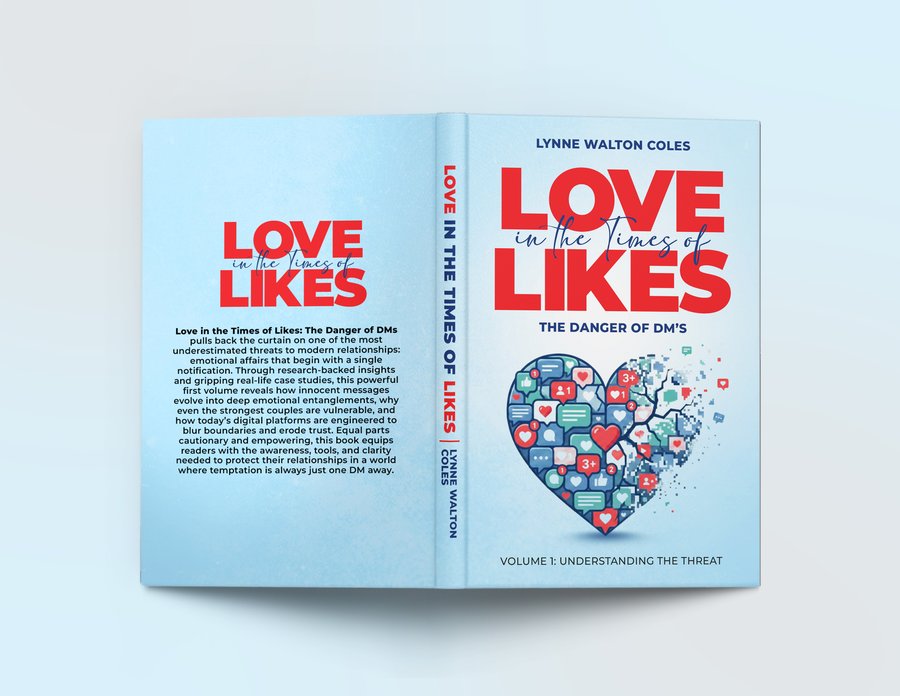
Love in the Times of Likes/The Danger of DM's
by Lynne Walton-Coles
MOST ADAPTABLE TO SCREEN BOOKY
Takes you to this book's Amazon page.
The judge's reasoning
Lynne Walton-Coles has written a book that knows exactly what it is and who it is for — and that clarity is rarer than it sounds.
Love in the Times of Likes opens with Susan finding a 2:47 a.m. notification — "I can't stop thinking about you either" — and doesn't let the reader exhale for three chapters. The hook is specific, credible, and immediately personal. The follow-through with Marcus and Elena's story demonstrates what good case-study writing looks like in the self-help space: the affair doesn't begin with a villain's decision, it begins with a friend request Marcus "accepted without much thought." That granularity — the Instagram comment about kids at the beach, the commute messages, the deleted threads — is what separates this from the generic infidelity-awareness titles already on the shelf.
The book's central argument is crisp and structural: traditional affair friction has been engineered away by platforms that profit from sticky engagement, and our relationship norms have not caught up. The 1985 thought experiment in Chapter 2 — what would it actually take to have an affair before the smartphone? — is the kind of concrete reframing that earns the self-help category. Walton-Coles returns to it usefully when she draws the parallel between a party flirtation and an identical Instagram exchange: "The behavior is identical. But somehow, because it is happening on social media, it feels different. Less real. Less serious. Less like a betrayal."
For readers who have typed "is it cheating if" into a search bar at midnight, this book offers the framework they couldn't find. That's a real market, and this book meets it with genuine specificity.

Judged by Arthur Beaumont — Non-Fiction · Memoir · Business · Self-Help
"A good non-fiction book changes one specific thing about your week."
Supporting passages
"It was 2:47 a.m. when Susan found the messages. She hadn't been snooping. Her husband's phone had buzzed on the nightstand—again—and the repeated notifications had finally pulled her from sleep. When she reached over to silence it, the screen lit up with a preview that made her heart stop. "I can't stop thinking about you either.""
A textbook opening hook that makes the book's central threat viscerally concrete before a single statistic is cited.
"Now think about what's required for a DM-based emotional affair: A smartphone: Which you already carry everywhere. A few spare minutes: While waiting in line, during your commute, in bed before sleep. Minimal effort: Just type and send. Low perceived risk: It's just messages; who's going to find out? The barriers have been removed. The friction is gone."
This structural comparison — traditional affair logistics versus DM affair logistics — is the book's core analytical argument, delivered with clean, memorable economy.
""You gave her the parts of yourself that should have been mine. You shared your thoughts, your feelings, your attention—everything I have been begging you for. And you gave it to someone else.""
Elena's confrontation line distills the emotional damage of the emotional affair into a single sentence that readers in this situation will recognize and likely underline.
Per-axis rubric scores
Every Booky-winning book is scored across all ten craft axes. The award category comes from the top axis; a second axis at or above 75 appears as secondary recognition.
Find out what your book does best.
Submit your book today. Get a real, honest, category-specific Booky — or every dollar back.
Submit Your Book → Screen Another Book