
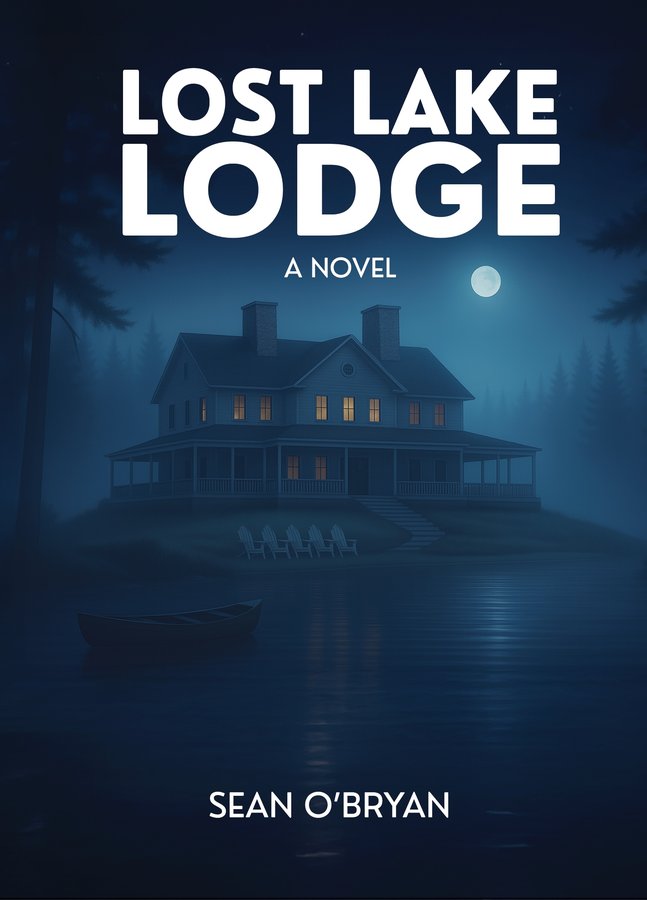
Lost Lake Lodge
by Sean O'Bryan
MOST IMMERSIVE SETTING BOOKY
Takes you to this book's Amazon page.
The judge's reasoning
Lost Lake Lodge earns its Booky on the axis of World-Building — not because it invents an elaborate fictional geography, but because it makes a real place feel mythologically inhabited. O'Bryan understands that a setting becomes world-building when it accumulates moral weight, and the Lodge carries plenty: tuberculosis sanatorium, state home for the unwanted, shelter for unwed mothers, family resort. The chapter "Marks of the Past" is the book's structural spine — a compressed, quietly devastating institutional history that earns the line "the Lodge remembers. Softly. Completely." That's not decoration. The Lodge has been listening for a century, and O'Bryan makes you feel that.
The nested timeline — Liam discovering Eliza Harper's grave in the present, then the flashback revealing how Eliza came to exist (Mary Harper's story, Judge Calloway's corruption, Hester Mills's quiet act of naming and witness) — is patient and purposeful. The grave marker inscription, "She leapt for freedom, but was caught by silence," could have been overwrought; instead it lands because O'Bryan has laid the ground carefully.
Characterization earns the secondary recognition. Paul and Mark's reconciliation on the porch is the book's most fully realized human scene — two men circling something enormous, with a father finally saying "That was fear, not love. I see that now" without the moment collapsing into sentimentality. Dot Prentice, sketched briefly, arrives with her own gravity: fierce loyalty delivered through cast-iron pans and silence. These are people shaped by the place they live in, which is exactly right for this kind of literary fiction.

Judged by Eleanor "Nell" Whitcombe — Literary Fiction · Prose & Style
"A sentence either earns its breath or it doesn’t."
Supporting passages
"The Lodge became a dumping ground for the forgotten—the mentally ill, the elderly without family, the poor, the disabled. There were no grand medical programs, no rehabilitation. Just bodies and names in ledgers, housed in fading rooms behind locked doors. Official records from that period are scarce. What survives are whispers."
The shift from bureaucratic diction to that final word — 'whispers' — is exactly the move that makes the Lodge's history feel haunted rather than merely historical.
"'I wasn't kind to you back before you first left.' Mark glanced over. Paul kept his eyes forward. 'Back then. In the pumphouse. After. I thought I was doing what a father should do. I thought if I stopped it, if I made you see how wrong it was, maybe it would just go away. That was fear, not love. I see that now.'"
Paul's confession earns its weight because O'Bryan has withheld it long enough — the pauses, the averted eyes, the halting syntax all belong to this specific man finally saying the true thing.
"Inside, Hester sat on the bed and studied her in the dim light. She should have felt afraid. Overwhelmed. But she didn't. For the first time since her husband left for war, something strong had taken root inside her. Quiet, steady, immovable. There was no ceremony. No naming paper. But as she looked down at the girl in her arms, she whispered: 'Eliza.'"
The restraint here — no ceremony, no naming paper, just a whisper pulled from a dog-eared novel — is the kind of earned quiet that makes grief and renewal land simultaneously.
Per-axis rubric scores
Every Booky-winning book is scored across all ten craft axes. The award category comes from the top axis; a second axis at or above 75 appears as secondary recognition.
Find out what your book does best.
Submit your book today. Get a real, honest, category-specific Booky — or every dollar back.
Submit Your Book → Screen Another Book