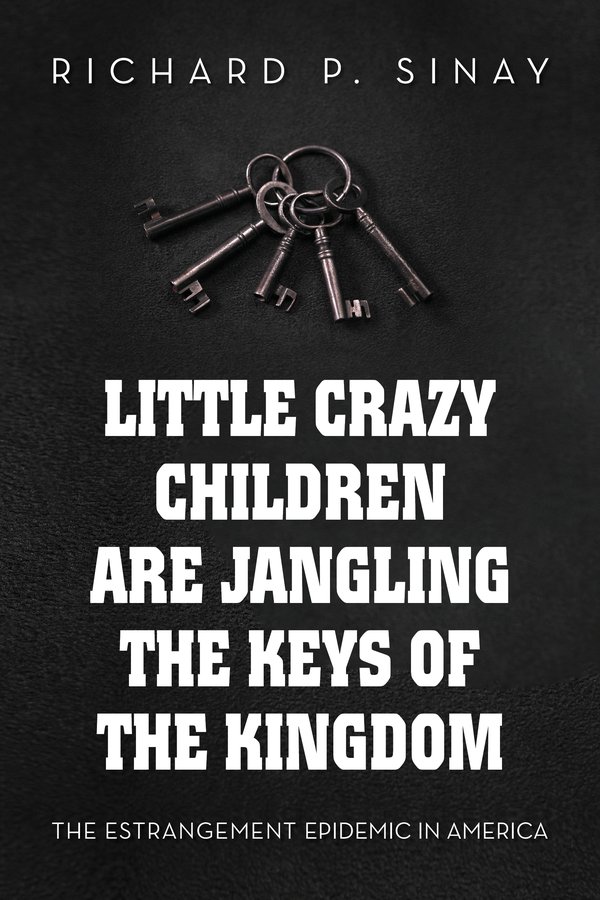
Little Crazy Children are Jangling the Keys of the Kingdom
by Richard P. Sinay
MOST POIGNANT READ BOOKY
The judge's reasoning
This is a book written from inside a wound, and its strongest quality is that the wound is on the page. Sinay does not report on estrangement from a safe clinical distance. He tells you what it did to his nights: the bad dreams in which he begs his son for forgiveness and is refused, the year or two of reading in his office until he was tired enough to sleep, the moment a lawyer told him he was estranged from his son and "it washed over me like the blood drains from one's body, and one can hardly stand up." His account of shame is the most specific writing in the book. He cannot answer when someone asks how old his grandchildren are, and he cannot tell friends how his kids are doing because he doesn't know.
The poem "Cause of Death: Broken Heart," with its doctors unable to find a medical reason a healthy man has died, is plain, unadorned and affecting. So is the closing email to his daughter-in-law, which asks for nothing and is therefore harder to read than any plea. For an estranged parent who has told no one, these pages offer the thing the preface promises: the news that they are not alone.
The hook is also well chosen. The title borrows John Proctor's line from The Crucible and sets estrangement beside the Salem witch hunts, giving the book a memorable frame. It addresses a topic with a large, underserved readership, and a clear place on the shelf beside Joshua Coleman's work, which Sinay engages throughout. This is a first-person account of loss, not a clinical guide, and as testimony it earns real recognition.

Judged by Arthur Beaumont — Non-Fiction · Memoir · Business · Self-Help
"A good non-fiction book changes one specific thing about your week."
Supporting passages
"It washes over a person like the blood drains from one's body, and one can hardly stand up."
Sinay ties Brené Brown's definition of shame to a specific, humiliating moment, being told by a lawyer that he was estranged from his son, and the physical detail makes the abstraction hurt.
"They said he never stopped working for his family nor let them down, / They said he never complained about caring for them when they were down. / They said he could have been better, but he did his best."
The poem's deadpan medical frame lets the grief land without melodrama, and it is the most controlled writing in the book.
"The witchcraft trials turned the world upside down so that those who used to be powerless were the ones in power; thus, they were "jangling the keys of the kingdom.""
The Crucible analogy gives the book a distinctive title and organizing metaphor that a reader will remember and repeat.
Per-axis rubric scores
Every Booky-winning book is scored across all ten craft axes. The award category comes from the top axis; a second axis at or above 75 appears as secondary recognition.
Find out what your book does best.
Submit your book today. Get a real, honest, category-specific Booky — or every dollar back.
Submit Your Book → Screen Another Book