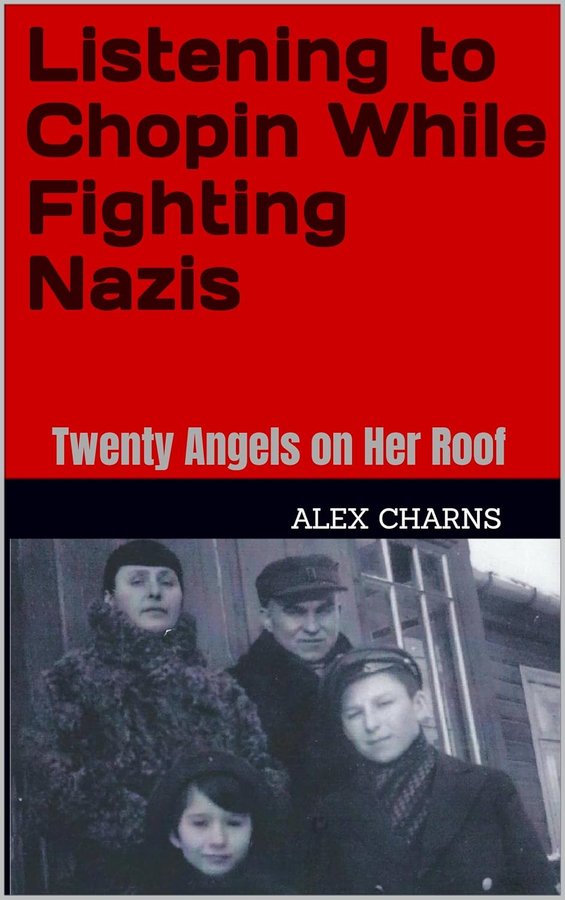
Listening to Chopin While Fighting Nazis
by Alex Charns
BEST TREATMENT OF IDENTITY BOOKY
Takes you to this book's Amazon page.
The judge's reasoning
This is an odd, unstable hybrid — a whimsical, angel-and-crow-populated wartime fable bolted onto a hard-nosed memoir of documentary reckoning — and the seam between them is exactly where the book earns its keep. The novella half never quite decides whether it's magical realism or catechism-class comedy (Baby Jesus sassing his mother, crow-poop slapstick), but the memoir half is genuinely substantive. Charns isn't writing nostalgia; he's conducting an inquest into his own family mythology, and he says so plainly: "Did my family lie to me about our Polish history?" The pivot from I Survived Hitler's Hell to the caption blaming "the rabbis and their rich coreligionists" is a gut-punch reveal handled with restraint — he lets the primary source indict itself. Then the discovery of In the Clutches of the Jews, apparently authored under his aunt's name with his grandfather's antisemitic postscript, escalates the stakes without melodrama. The through-line — a lawyer trained to distrust official lies (his FBI/Supreme Court files work, later published as Cloak and Gavel) turning that same forensic skepticism on his own bloodline — gives the book a real argument: inherited heroism narratives deserve the same scrutiny as government cover-ups. That's a takeaway a reader can use, not just admire. The self-implicating honesty ("I'm ashamed of myself" re: the courtroom Nazi comparison) keeps the narrator credible rather than self-mythologizing.

Judged by Arthur Beaumont — Non-Fiction · Memoir · Business · Self-Help
"A good non-fiction book changes one specific thing about your week."
Supporting passages
"Did my family lie to me about our Polish history? I was lied to when I was told that Jews falsely accused Poles, in general, of being antisemitic. When someone in power lies to me, my revenge is to spend a decade or more proving the lie."
States the book's real thesis — turning a lawyer's forensic instinct against his own family's inherited mythology.
"His go-to was blaming the rabbis and rich Jews. No mention of Nazis, Germans, genocide, or the Final Solution. He wrote this book in 1954 in the safety of the USA, knowing what Hitler had intended for the Jews."
The unflinching self-indictment of a family document is a rare, uncomfortable move for a memoir built on heroic lore.
"Twenty angels and an SS man in pink panties. It was quite a sight. The angels laughed too."
Shows the novella's committed, strange tonal register even where it risks tipping into farce.
Per-axis rubric scores
Every Booky-winning book is scored across all ten craft axes. The award category comes from the top axis; a second axis at or above 75 appears as secondary recognition.
Find out what your book does best.
Submit your book today. Get a real, honest, category-specific Booky — or every dollar back.
Submit Your Book → Screen Another Book