
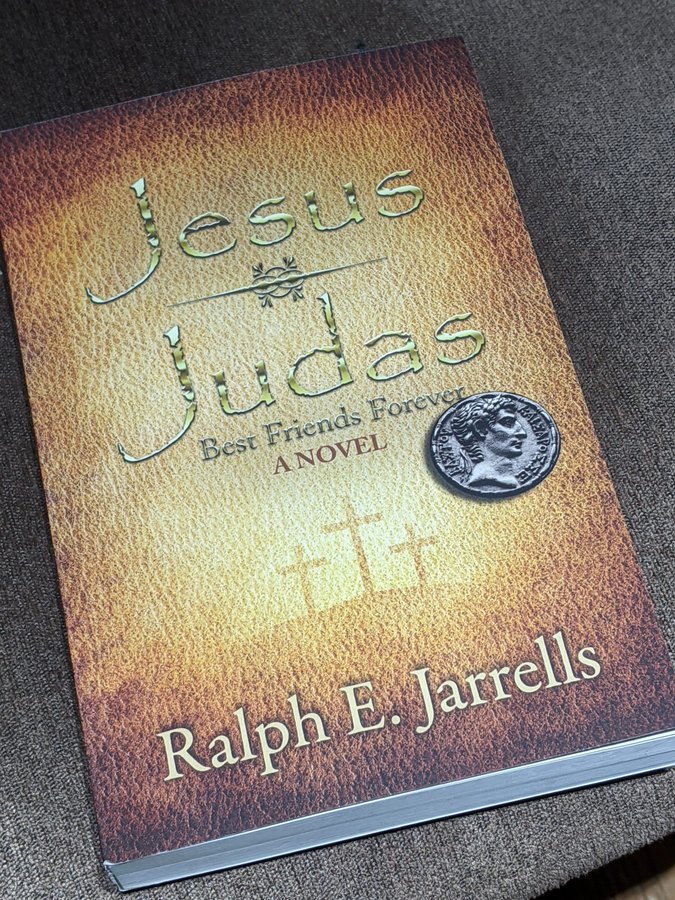
"Jesus-Judas: Best Friends Forever"
by Ralph Jarrells
MOST SENSORY WORLDBUILDING BOOKY
Takes you to this book's Amazon page.
The judge's reasoning
Ralph Jarrells has done something genuinely useful in Jesus-Judas: Best Friends Forever: he has built a tactile, historically grounded world around events that most readers know only as scripture. The manuscript's most consistent strength is its patient accumulation of material detail — the birthing chair Simon constructs for Leah (padded, center cut out, tall enough for the midwife's chair beneath), the penny royal crushed to smell like spearmint and freshen the room, the purifying oil of myrrh and sandalwood and frankincense that carries 'a gentle aroma of sweet lemons.' This is not decorative research; it serves the book's central argument, spelled out plainly in the Author's Comments: that we fail to read the Bible because we strip its events of their physical and cultural context. When Jarrells plants two doves on Maryamor's shoulders at the moment the priest requires them for the sin offering — first at the Bris in Bethlehem, then again at the Women's Gate in Jerusalem — the repeated miracle lands because the reader has been given enough ritual scaffolding to understand what the absence of doves would have meant. The contrasted births of Judah in a grand Alexandria palace and Jesus in a Bethlehem stable are handled with structural confidence: the wealth of ceremony around Judah's Bris (Hillel the Elder, the Minyan, the feast, the flowing wine) set against the humble efficiency of old Rebeka wielding her well-worn Izmal in a stable and walking off with a goat. This parallel architecture gives the book its thesis in scene rather than sermon, which is its most literary instinct. The Theme & Substance score reflects how earnestly and specifically the book delivers on its stated intent: to restore the lived texture of first-century Jewish life to a story most readers have inherited as abstraction.

Judged by Eleanor "Nell" Whitcombe — Literary Fiction · Prose & Style
"A sentence either earns its breath or it doesn’t."
Supporting passages
"A horn of pure olive oil (for lubrication and to soothe the baby's skin), folded pieces of cloth for fomentations (compresses to alleviate pain), sea sponges, pieces of woolen cloth for modesty to cover her during the birthing process, bandages to swaddle the baby, a small clay pot of sea salt (an antiseptic to wash Leah and the baby), a fresh skin of wine (for its antiseptic qualities) and containers of penny royal (when crushed the leaves smell like spearmint to freshen the birthing room) and barley groats (to make a tea to relieve heartburn and stomach cramps) and platters of apples and quince (also to freshen the air in the room)…"
This inventory of a first-century Jewish birthing room does exactly what the book promises: it restores the physical reality of a world readers have received only as doctrine.
"There was no Elijah chair, no Minyan, no celebration, no visiting celebrities, no Pharisees, no Mohel. The differences between the circumcisions of Judah and Jesus were as different as their births."
The plainness of the sentence earns its moral weight — the structural contrast between the two circumcisions carries the book's central theological argument more efficiently than any commentary passage.
Per-axis rubric scores
Every Booky-winning book is scored across all ten craft axes. The award category comes from the top axis; a second axis at or above 75 appears as secondary recognition.
Find out what your book does best.
Submit your book today. Get a real, honest, category-specific Booky — or every dollar back.
Submit Your Book → Screen Another Book