
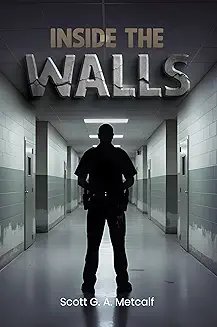
Inside the Walls
by Scott G. A. Metcalf
BEST WORLDBUILDING ECONOMY BOOKY
Takes you to this book's Amazon page.
The judge's reasoning
Inside the Walls earns its strongest marks for the visceral, fully inhabited world Metcalf constructs from the first paragraph. This is not a prison described from the outside looking in — it is rendered from the inside, sensory layer by sensory layer. The opening chapter's smell-first entry is genuinely effective: "It smelled of industrial-strength disinfectant battling a losing war against the less definable odors of despair, sweat, and stale cigarette smoke" is the kind of line that puts you physically in the corridor. Metcalf sustains this throughout — the "symphony of confinement," the fluorescent hum "burrowing into my skull," the polished steel reflection showing "a pale, wide-eyed kid in a uniform that still looked too new" — these are not generic atmosphere-setting moves; they accumulate into a genuinely immersive sense of place.
The book's second strength is characterization, particularly the creation of Officer Miller. Miller arrives as a type — the grizzled veteran — but Metcalf earns him specificity: the permanently affixed cigarette, the "voice laced with years of dust and cigarette smoke," and crucially, the third rule that complicates everything cynical about the first two. When Miller says "the enemy is the part of you that starts to forget... the part that lets this place chip away at your own humanity," he transcends stock mentor and becomes someone whose contradictions the reader actually wants to understand. Sergeant Henderson's PowerPoint confrontation — "We just call it survival" — lands with similar economy and wit. These men feel earned, not assembled from correctional-officer archetypes.
The memoir's thematic argument — that survival inside requires simultaneously hardening and preserving one's humanity — is stated clearly and reinforced through scene rather than just assertion. That's the mark of non-fiction that knows what it's doing.

Judged by Arthur Beaumont — Non-Fiction · Memoir · Business · Self-Help
"A good non-fiction book changes one specific thing about your week."
Supporting passages
"The air hit me first, a thick, cloying miasma that was at once sterile and stagnant. It smelled of industrial-strength disinfectant battling a losing war against the less definable odors of despair, sweat, and stale cigarette smoke. Even before the steel gates groaned open, admitting me into a world that would redefine my understanding of reality, the scent clung to the back of my throat, a preview of the suffocation to come."
The sensory specificity of this opening — smell as the primary entry point — grounds the memoir's world-building in lived experience before a single policy or statistic is mentioned.
""The enemy is the system that put them here, the circumstances that made them who they are, and the rot that festers in their hearts. But more importantly, the enemy is the part of you that starts to forget. The part that starts to see them as less than human. The part that lets this place chip away at your own humanity. Because if you let that happen, you become them. And then you're truly lost.""
Miller's third rule pivots against the reader's expectation and against the character's own cynical grain, making him a genuinely complex figure rather than a genre-standard hardcase.
""We just call it survival. And right now, my team needs me out there, not in here listening to PowerPoints.""
Henderson's single line distills the book's central tension — institutional abstraction versus floor-level reality — with the economy that good non-fiction argument demands.
Per-axis rubric scores
Every Booky-winning book is scored across all ten craft axes. The award category comes from the top axis; a second axis at or above 75 appears as secondary recognition.
Find out what your book does best.
Submit your book today. Get a real, honest, category-specific Booky — or every dollar back.
Submit Your Book → Screen Another Book