
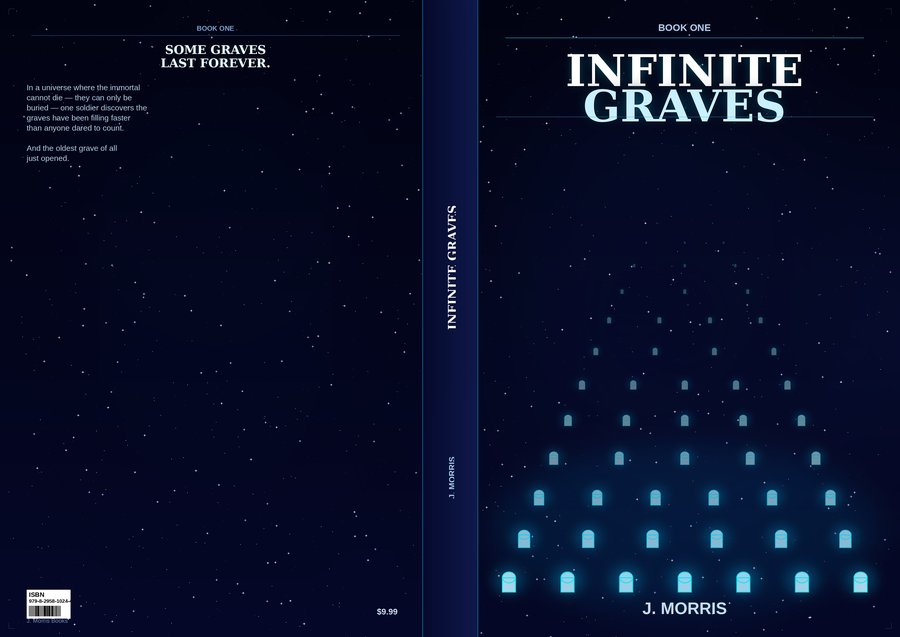
Infinite Graves
by J. Morris
BEST VOICE DEBUT BOOKY
Takes you to this book's Amazon page.
The judge's reasoning
Infinite Graves earns its breath at the sentence level in a way that genuinely surprised me. J. Morris writes with a rhythmic intelligence that understands when to compress and when to let a moment breathe — and more importantly, knows the difference. The opening inventory of ceiling stains — Florida, Peach, Smudge — is a compressed character study disguised as a hospital detail, and it pays forward beautifully when Mack whispers goodbye to two of them and not the third. "You never quite finished. There was always one more thing." That's not an observation about Mack's death; it's a sentence about being alive, and Morris lands it without announcing it.
The prose is at its best in the body-reawakening sequence: the return of sensation in the borrowed apartment, the flexed ankle, the toe that twitches on command. Morris understands that specificity is the engine of emotional truth — "the slight elevation change in her left calf muscle" from stepping over a root does more work than any amount of explicit feeling. The running sequence, Mack crossing the Shelby Avenue bridge with tears streaming back across her temples, earns its length because each paragraph earns the next one.
The thematic architecture is quietly ambitious: the same ritual of naming — ceiling stains, plaster cracks, orange juice brands — becomes the book's spine, a philosophy of self-location through small claims. This is a book about what it costs to still be here, and the prose doesn't flinch from that. The voice is singular. It could only have been written by this writer.

Judged by Eleanor "Nell" Whitcombe — Literary Fiction · Prose & Style
"A sentence either earns its breath or it doesn’t."
Supporting passages
"She had been a runner once. Now she was ceiling tile."
Six words of self-definition that do more compression work than a paragraph of backstory — the contrast is devastating precisely because it refuses to elaborate.
"She had forgotten what it felt like to send a signal and have it arrive. Her brain had been transmitting for two years into silence, into the specific particular silence of a body that was present but not answering, and she had rebuilt her entire understanding of herself around that silence."
This passage earns its length because it locates the emotional catastrophe not in the physical loss but in the cognitive adaptation to it — the forgetting of what wholeness felt like — which is the harder, truer grief.
"She made herself know it."
The final line of the excerpt — Mack memorizing a ceiling crack in the new timeline — closes the book's thematic loop: self-location through deliberate, small acts of naming is the only anchor available to a person who cannot trust continuity.
Per-axis rubric scores
Every Booky-winning book is scored across all ten craft axes. The award category comes from the top axis; a second axis at or above 75 appears as secondary recognition.
Find out what your book does best.
Submit your book today. Get a real, honest, category-specific Booky — or every dollar back.
Submit Your Book → Screen Another Book