
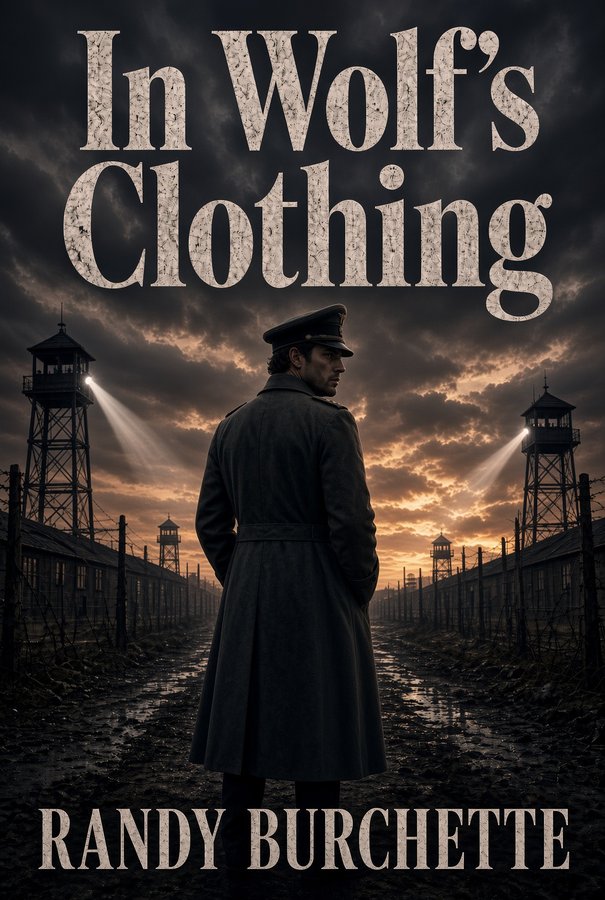
In Wolf's Clothing
by Randy Burchette
BEST TREATMENT OF GRIEF BOOKY
The judge's reasoning
Burchette has chosen ground that historical fiction too rarely walks fully onto: the specific, doubled persecution of gay Jewish men under the Nazi regime, refracted through a relationship where the two lovers end up on opposite sides of the wire. That's a real premise, and the book commits to its harshest implications rather than softening them. The scene where Rolf is forced to process Josef into Sachsenhausen — filling in the intake form he already knows the answers to, asking "Occupation?" of the man he once brought breakfast in bed — is the book's best sustained idea, using bureaucratic repetition to dramatize betrayal. Armin's introduction, and the unflinching detail of the abuse Rolf interrupts, extends the theme rather than using the camp as mere backdrop: this is a book interested in what complicity costs a person who still thinks of himself as decent.
The emotional peak is the hanging itself, and to the manuscript's credit, it doesn't look away or rush past it — the "savage thunk," the legs, the rain falling after — followed by Rolf's insomnia and his decision that inaction is no longer bearable. That turn, from self-protective compromise to active resistance, is the moral spine of the book, and it's earned by the accumulated small betrayals (the extra rations, the averted eyes, the uniform) that precede it. The dedication to those who "stood up for their fellow humans and tried to do the right thing" is not incidental; the manuscript is building toward Rolf becoming that person, and Armin's revelation that Josef still spoke of loving him gives the theme its emotional payoff. The prose itself is often plain and occasionally over-explained, but the substance underneath is genuinely serious and handled with care rather than exploitation.

Judged by Eleanor "Nell" Whitcombe — Literary Fiction · Prose & Style
"A sentence either earns its breath or it doesn’t."
Supporting passages
""Name," the guard said... "You know my name," Josef muttered through welling emotions. "State your name.""
The bureaucratic interrogation scene converts institutional cruelty into intimate betrayal without needing to editorialize.
"The world narrowed to the savage thunk of Josef's body dropping, the frenzied whipping of his legs, the rattled gasp of air fighting to get past the tightening rope."
The hanging is rendered with unflinching, controlled detail rather than melodrama, earning its emotional weight.
Per-axis rubric scores
Every Booky-winning book is scored across all ten craft axes. The award category comes from the top axis; a second axis at or above 75 appears as secondary recognition.
Find out what your book does best.
Submit your book today. Get a real, honest, category-specific Booky — or every dollar back.
Submit Your Book → Screen Another Book